Skip to content
Year-End Sale is Live Now - Up to 50% off
New users? Get 5% off on your first purchase.
Free US shipping over $100
Year-End Sale is Live Now - Up to 50% off
New users? Get 5% off on your first purchase.
Free US shipping over $100

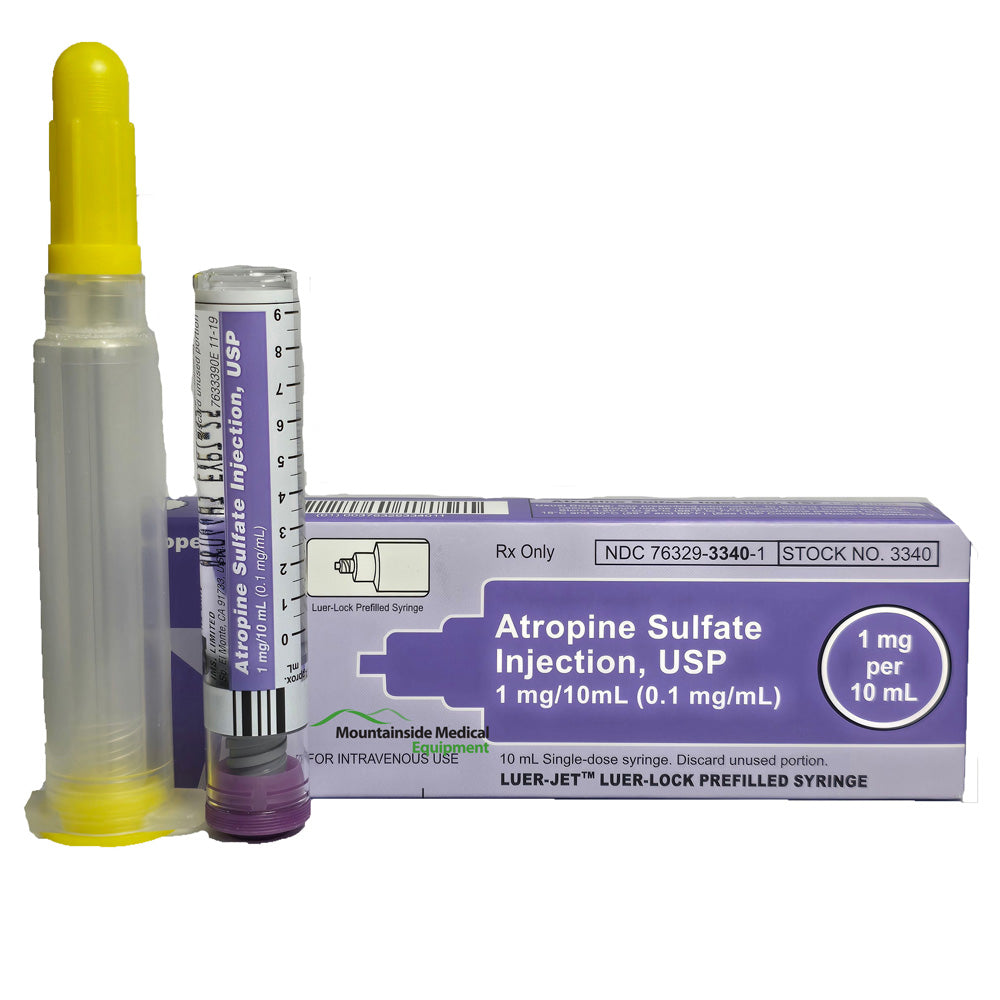
Atropine Sulfate Injection Prefilled Syringe 0.1 mg/10 mL Luer-Jet 10 mL (EACH) (Rx)

Year End Sale 12%
Original price $ 33.95
Current price $ 29.90
SKU 76329-3340-01ea
*Mountainside Medical does not fill personal prescriptions Medical Professional License Required to Unlock Account

How to Order:

Send an email request to: sales@mountainside-medical.com

You will receive instructions on how to create an account along with Rx Ordering Details.

(Note: Acceptable licenses must have Prescriptive Authority in the license issuing state.)

Atropine Sulfate Injection prefilled syringe is used in emergency medical situations to increase heart rate in patients experiencing bradycardia (slow heart rate) or to counteract the effects of certain types of nerve agent and pesticide poisoning. It functions by blocking the parasympathetic nervous system, thereby inhibiting excessive vagal activity. Additionally, atropine is used as a pre-anesthetic to reduce salivation and respiratory secretions. The prefilled syringe facilitates rapid administration in critical care settings.

Atropine Sulfate Injection Prefilled Syringe by International Medication Systems is designed for rapid and effective cardiac care and emergency response. Each syringe delivers 0.1 mg of atropine sulfate per 10 mL, offering precise dosing to treat bradycardia (slow heart rate) and reduce muscarinic symptoms in organophosphate poisoning. The prefilled syringe with a Luer-Jet connector ensures quick preparation and administration, providing healthcare professionals with a reliable tool for emergency interventions. Compact and ready-to-use, this solution is ideal for hospitals, emergency medical services, and other clinical settings demanding immediate therapeutic action.

Product Details:

Active Ingredient: Atropine Sulfate, 0.1 mg per 10 mL
Formulation: Sterile, aqueous solution, prefilled for immediate injection

Indications: 

  • Emergency treatment of clinically significant bradycardia
  • Antidote for organophosphate poisoning or to reduce salivation and bronchial secretions prior to surgery

Mechanism of Action:

Atropine is an anticholinergic agent that inhibits muscarinic acetylcholine receptors in cardiac and smooth muscle, leading to increased heart rate and reduced smooth muscle activity, respiratory secretion, and CNS activity.

Administration Instructions:

  • Only for intravenous (IV) or intramuscular (IM) administration by a healthcare professional.
  • Compatible with various medical device interfaces via the Luer-Jet connector.
  • Dosage tailored to patient condition and clinical response, typically involving gradual administration in acute settings.

Packaging:

Available as a 10 mL prefilled syringe designed for immediate deployment.
Luer-Jet adapter allows seamless integration with existing medical apparatus.

Storage:

  • Store at controlled room temperature, 20°C to 25°C (68°F to 77°F).
  • Protect from excessive light and any form of freezing.
  • Ensure accessibility for quick use in emergencies.

Precautions:

  • Intended for professional use only; must be administered under clinical supervision.
  • Caution in patients with glaucoma, bladder obstruction, or certain heart conditions.
  • Monitor patients for adverse reactions including excessive cardiac stimulation or anticholinergic effects.

Possible Side Effects:

  • Common reactions include dry mouth, blurred vision, and urinary retention.
  • May cause tachycardia and CNS disturbances in sensitive individuals or upon overuse.
  • Serious allergic reactions are rare but require immediate medical attention.

The Atropine Sulfate Injection Prefilled Syringe by International Medication Systems provides a critical resource for timely and efficient response to cardiac emergencies and toxic exposures. With its easy administration and reliable performance, this product stands as a dependable ally for medical professionals facing urgent care scenarios.

Atropine Sulfate Injection Prefilled Syringe 0.1 mg/10 mL Luer-Jet 10 mL (EACH) (Rx)
$ 33.95 $ 29.90
🔒 Medical License Required
FAQs for Atropine Sulfate Injections
  • What Is Atropine Sulfate Injection For?

    Atropine sulfate injection is a fast-acting, prescription emergency medication used to: Treat bradycardia (dangerously slow heart rate) Reverse cholinergic toxicity (organophosphate or nerve agent poisoning) Reduce secretions before surgery Counteract vagal reflexes during anesthesia and medical procedures Occasionally used in advanced cardiac life support (ACLS) protocols

  • Is Atropine Safe in Pregnancy?

    Atropine is classified as pregnancy category C. It should be used in pregnancy only if clearly needed and prescribed by a doctor, as there is limited data on risks; discuss carefully with your healthcare provider.

  • How Long Does an Atropine Injection Last?

    Immediate effects typically start within 2–4 minutes of IV administration. Duration of action: usually 30–60 minutes but may last longer depending on dose and route.

  • Can Atropine Cause Seizures?

    Seizures are a rare side effect, more likely at high doses or with overdose. Atropine can cause central nervous system stimulation, especially in children or people with underlying neurologic issues.

  • Why Would Someone Be Given Atropine?

    Bradycardia (slow heart rate) management Pre-anesthetic to decrease saliva/secretions Antidote for pesticide/organophosphate poisoning Management of certain eye and airway procedures

  • What Are the Benefits of Atropine Injection?

    Rapid reversal of bradycardia during emergencies Life-saving in cases of nerve agent or organophosphate poisoning Decreases secretions to improve intubation/airway safety preoperatively Counters excessive vagal (parasympathetic) responses

  • What Does Atropine Do to the Brain?

    Blocks acetylcholine receptors in the brain, which can cause agitation, confusion, or delirium at higher doses. Used with caution in elderly or patients with cognitive impairment.

  • Is Atropine a High Risk Drug?

    Yes, atropine is a high-alert medication due to potential for dangerous side effects including severe tachycardia, cardiac arrhythmia, agitation, or overdose.

  • Is Atropine a Sedative?

    No, atropine is not a sedative. It is an anticholinergic agent; its primary action is to block parasympathetic activity, not to sedate the patient.

  • Why Is Atropine Used in Labor?

    Rarely, atropine can be used to reverse severe bradycardia in the mother or during emergency situations in pregnancy or C-section; not common in routine obstetric care.

  • What Does Atropine Do to the Heart?

    Increases heart rate by blocking vagal (parasympathetic) influence Can be life-saving in severe bradycardia or asystole.

  • How Long Until Atropine Wears Off?

    Effects commonly subside within 1 hour, but some symptoms (dry mouth, blurred vision) may last longer.

  • What Is the Next Step After Atropine?

    If bradycardia remains unresolved, ACLS guidelines recommend transcutaneous pacing or advanced cardiac medications. For poisoning, repeated atropine doses and supportive care may be necessary.

  • What Should I Avoid While Taking Atropine?

    Avoid extreme heat (risk of decreased sweating/overheating) Avoid driving or hazardous activities if vision is blurred or you feel confused. Be cautious with other medications with anticholinergic effects.

  • Can Atropine Cause a Stroke?

    Atropine does not directly cause stroke, but can raise heart rate and blood pressure. Caution is used in patients with cardiovascular risk.

  • Why Use Atropine Injections?

    Instant response for critical slow heart rhythm or dangerous poisonings Prevents excessive airway secretions during surgery Essential component in emergency medical services and hospitals

  • Can Atropine Cause Memory Loss?

    Short-term confusion, agitation, or memory impairment can occur, especially at high doses or in the elderly—reversible on stopping the drug.

  • Why Do Doctors Prescribe Atropine?

    To treat bradycardia, manage acute poisoning, reduce secretions, or facilitate certain medical procedures where anticholinergic effects are needed.

  • Can Atropine Raise Blood Pressure?

    Yes, it may cause a moderate increase in blood pressure due to increased heart rate.

  • When Not to Use Atropine?

    Glaucoma (narrow angle) Obstructive uropathy, ileus, myasthenia gravis (unless for reversal) Known allergy to atropine Serious cardiovascular instability (unless life-threatening bradycardia)

  • Why Choose Our Atropine Sulfate Injections?

    USP-Grade, hospital-trusted formulation Rapid IV/IM/SC administration for critical emergencies Tamper-evident, sterile single and multi-dose vials Used globally by EMS, anesthesiologists, and in all levels of hospital care Essential for bradycardia, poisoning, airway, and surgical protocols Clear dosage, administration, and safety documentation

Search Any Type of Product, Medication, or Alignment