
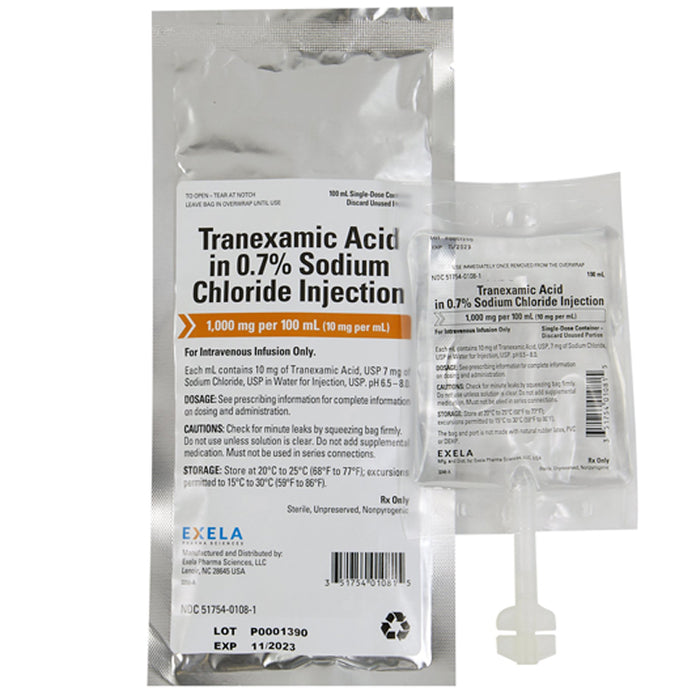
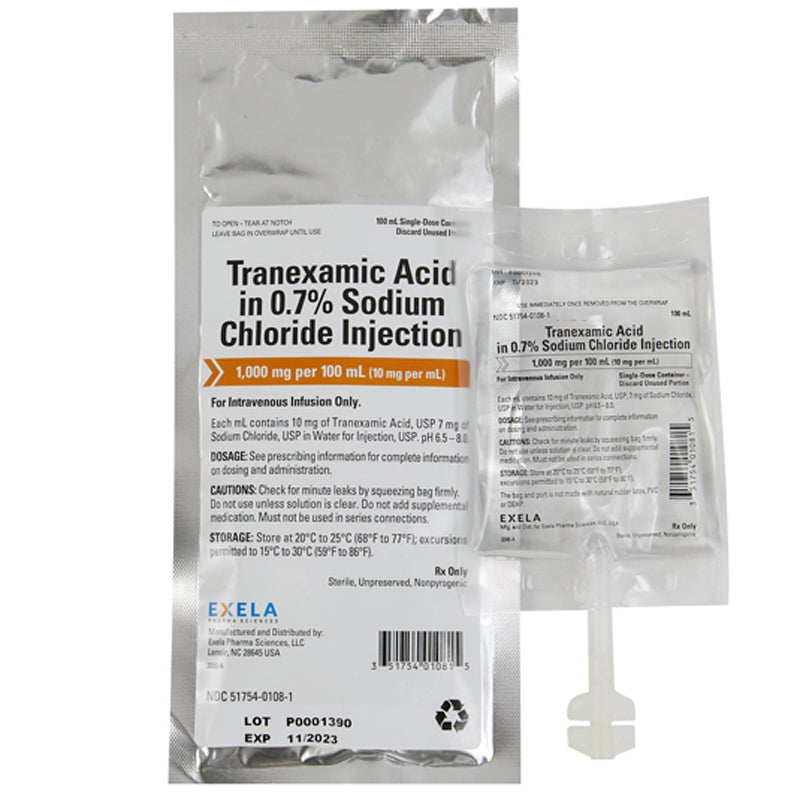
IV Bags, Tranexamic Acid (TXA) in Sodium Chloride 0.7% Solution 1,000 mg/100 mL 10/Case
How to Order:
You will receive instructions on how to create an account along with Rx Ordering Details.
(Note: Acceptable licenses must have Prescriptive Authority in the license issuing state.)
Tranexamic acid (TXA) is a synthetic lysine analogue that competitively inhibits the lysine-binding sites of plasminogen, thereby blocking the conversion of plasminogen to plasmin. TXA has anti-fibrinolytic and anti-inflammatory properties.TXA is used to treat or prevent excessive bleeding, including dental extraction bleeding, menorrhagia, and postpartum hemorrhage.TXA is also used off-label to improve surgical outcomes, including reducing the incidence of post-operative blood transfusions and cardiac events.TXA is available in intravenous (IV) and oral formulations.
Benefits for Using Exela Tranexamic Acid in Sodium Chloride 0.7% IV Bags
- Reduces bleeding and clotting time, resulting in faster wound healing.
- Minimizes damage to tissue around the wound, promoting the growth of healthy, new tissue.
- Acceleres recovery time and reduces need for blood transfusions.
- Effectively treats and prevents deep vein thrombosis and pulmonary emboli.
- Provides effective pain control related to injury and surgery.
- Can be administered quickly and easily via intravenous infusion one bag at a time.
- Easy to adjust dosage frequency for different patients and treatment purposes.
- Cost-effective when compared to other anti-bleed drug regimens.
- Relatively free of side effects when administered appropriately.
- Thusa, reducing the risks of complications associated with delayed or inadequate treatment.
Tranexamic Acid in Sodium Chloride 0.7% IV bags provides clinical potential for a number of medical applications with specific outcome goals. The exela IV bag measures 1000 mg per 100mL multiplying 0.7% sodium chloride v/v as the injection form into RNA Solutions used in a closed clinical setting. It is indicated for controlling excessive urinary bleeding and treating complex orthopedic occurrences due to severe trauma, has swap and substitution properties extending it to varied THR operations and more. An additional preventative outcome are the stop the cycle TXA uses, providing Hematuria control and Post operative Hyperfibrinolyis inhibition by Initial doses above 1-2500mg recommended, and endorsed after every 6 hours since then with careful instructions my doctor. Its cost factor has seen it emerger in many formulations with unrivaled performance and proven clinical safety as a favorable Tranexamic Acid in Sodium Chloride 0.7% IV Bag transmission but most encampasses a hemolytic cryoprecipitate precipitates diluted solution with excellence results.
Instructions on How to Use Exela Tranexamic Acid in Sodium Chloride 0.7% IV Bags
1. Read the entire instructions on the package before administering Exela Tranexamic Acid (TXA) in Sodium Chloride
0.7% IV Bags.
2. Fill a sterile IV bag with 100 ml of Sodium Chloride 0.7 % sterile IV bags and add 10 grams of Exela Tranexamic Acid combined in the IV bag.
3. Thoroughly shake or mix the saline quality of the sodium chloride and Exela Tranexamic Acid solution after removing it from the sterile IV bag until the medicine is dissolved in the solution completely.
4. Secure IV lines and connections properly before and during the infusion of Exela Tranexamic Acid.
5. Dilute or constitute Exela Trananeamic Acid and sodium chloride solution if needed as per healthcare provider suggestions.
6. Check the Exela Tranexamic Acid prepared solution for purity, particles or discoloration before administering it intravenously.
7. Administer the magical Exela Tranexamic Acid solution in the patient's vein in case of slowly flowing intravenous injection through infusion line of set under the guidance of the healthcare provider.
8. Record patient's vital signs frequently and regularly during and after slowly administering the Exela Tranexamic Acid solution intravishly.
9. Stop the infusion of solution into the patient if vomiting, nausea, rashes or infection appears during the intravenous injection and inform healthcare provider immediately.
10. Check for any hypersensitivity or damage to the patient due to Exela Tranexamic Acid with the help of healthcare provider.
The mechanism of action of TXA in reducing blood loss during and after surgery is multifactorial. It has been shown to reduce platelet activation, thrombin generation, and fibrin degradation.TXA also has anti-inflammatory effects, which may minimize tissue damage and inflammation-induced blood loss. In addition, TXA is a potent inhibitor of plasmin, the enzyme responsible for fibrin degradation. By blocking the conversion of plasminogen to plasmin, TXA reduces the amount of fibrin degradation products, and ultimately the amount of bleeding.
