Skip to content
Year-End Sale is Live Now - Up to 50% off
New users? Get 5% off on your first purchase.
Free US shipping over $100
Year-End Sale is Live Now - Up to 50% off
New users? Get 5% off on your first purchase.
Free US shipping over $100

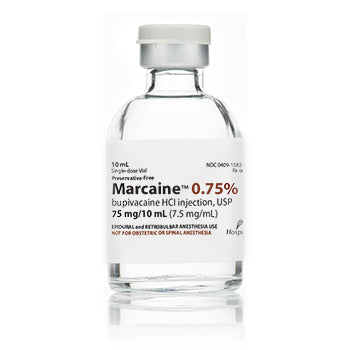
Marcaine (Bupivacaine Hydrochloride) 0.75% Injection 10 mL Vials, 10/pack (Rx)

Year End Sale 27%
Original price $ 139.95
Current price $ 102.00
SKU 00409-1582-10
*Mountainside Medical does not fill personal prescriptions Medical Professional License Required to Unlock Account

How to Order:

Send an email request to: sales@mountainside-medical.com

You will receive instructions on how to create an account along with Rx Ordering Details.

(Note: Acceptable licenses must have Prescriptive Authority in the license issuing state.)

Marcaine (Bupivacaine Hydrochloride) 0.75% Injection is a local anesthetic used to provide long-lasting pain relief during surgical, dental, and obstetric procedures. It works by blocking nerve signals in specific areas of the body, preventing the sensation of pain. Marcaine is particularly effective for regional anesthesia techniques such as epidurals, nerve blocks, and spinal anesthesia, making it ideal for managing pain in complex procedures, labor and delivery, and postoperative recovery.

Details and Features

  • Active Ingredient: Bupivacaine Hydrochloride
  • Concentration: 0.75% (7.5 mg/mL)
  • Volume: 10 mL per vial
  • Packaging: 10 vials per pack
  • Formulation: Sterile solution for injection
  • Usage: Used for local or regional anesthesia during surgeries, dental procedures, or chronic pain management.
  • Manufacturer: Pfizer Injectables

Mechanism of Action

Bupivacaine works by binding to and inhibiting voltage-gated sodium channels on nerve cells. This action blocks nerve impulse generation and propagation, thereby providing a local anesthetic effect. Bupivacaine has a longer duration of action compared to other local anesthetics, making it particularly useful for prolonged surgical procedures or pain relief.

Warnings

  • Cardiovascular Risks: Potential for cardiovascular complications including hypotension and arrhythmias; use with caution in patients with cardiovascular disease.
  • Central Nervous System Effects: Risk of central nervous system toxicity, including seizures, especially if administered intravascularly.
  • Allergic Reactions: Rare potential for hypersensitivity reactions; contraindicated in patients with known allergies to amide-type anesthetics.
  • Pregnancy: Should be used cautiously in obstetric anesthesia due to potential effects on the mother and fetus.
  • Injection Technique: Must be meticulously administered to avoid accidental intravascular injection.
  • Contraindications: Avoid use in intravenous regional anesthesia (Bier block).

Side Effects

Common Side Effects:

  • Local irritation at the injection site
  • Dizziness
  • Nausea or vomiting
  • Sensations of tingling or numbness

Serious Side Effects:

  • Cardiovascular: Arrhythmias, bradycardia, cardiac arrest
  • CNS Toxicity: Seizures, confusion, nervousness
  • Respiratory distress: Difficulty breathing in severe cases
  • Allergic Reactions: Urticaria, rash, or anaphylactic reactions

Administration and Monitoring

Marcaine should be administered by healthcare professionals experienced with regional anesthesia and the management of potential complications. Continuous monitoring of the patient's cardiovascular and respiratory status is advised during administration. Emergency resuscitative equipment and medications should be immediately available in case of adverse reactions. Dosage should be tailored to the individual needs of the patient and the specific procedure being performed, taking special care in patients with underlying health conditions that may influence their reaction to the drug.

Marcaine (Bupivacaine Hydrochloride) 0.75% Injection 10 mL Vials, 10/pack (Rx)
$ 139.95 $ 102.00
🔒 Medical License Required
FAQs for Lidocaine Injections
  • What Is a Lidocaine Injection Used For?

    Lidocaine injection is widely used for: Numbing specific areas before procedures (e.g., dental work, skin surgery) Blocking nerve pain (nerve block injections, epidurals) Relieving muscle/joint pain Treating heart rhythm problems (as an antiarrhythmic agent)

  • Lidocaine Dosage and Administration

    Typical dose depends on site and procedure (consult your healthcare provider). Administered intradermally, subcutaneously, or intramuscularly. NEVER self-inject without medical supervision!

  • How long does lidocaine last if injected?

    Lidocaine typically provides pain relief for 1 to 3 hours, depending on the dose, injection site, and individual response.

  • Why do numbing injections hurt so bad?

    The initial sting may be due to needle insertion or the acidic pH of the solution. Discomfort is brief and quickly followed by numbness.

  • Can lidocaine cause vomiting?

    Yes, nausea and vomiting are potential but uncommon side effects of lidocaine.

  • Where should you NOT inject lidocaine?

    Avoid injecting into arteries, infected areas, or near major nerves. Use extreme caution around the spinal cord and head/neck.

  • How painful is a lidocaine injection?

    Most patients feel a quick pinch or burning lasting just a few seconds.

  • What kind of pain is lidocaine good for?

    Lidocaine is highly effective for acute pain, minor surgery, nerve pain, and dental pain.

  • How much time does a lidocaine injection take to work?

    Lidocaine starts numbing the area within 1 to 3 minutes after injection.

  • Is lidocaine an opioid?

    No, lidocaine is a local anesthetic, NOT an opioid. It does not cause addiction.

  • What happens if lidocaine hits a nerve?

    It may cause temporary numbness, tingling, or rarely, nerve injury if directly injected.

  • Does lidocaine injection make you sleepy?

    Lidocaine usually does not cause drowsiness at standard doses but high doses can lead to CNS effects.

  • Will lidocaine raise your blood pressure?

    Lidocaine does not normally raise blood pressure; however, overdoses can affect heart function.

  • How long does lidocaine stay in your bloodstream?

    Lidocaine is metabolized within 1.5 to 2 hours, but traces can remain longer based on dose and liver function.

  • What does lidocaine do to the heart?

    Lidocaine is used to treat arrhythmias; in rare cases, overdose can cause heart problems.

  • How deep does a lidocaine injection go?

    Depends on purpose: subcutaneous, intradermal, or deeper (nerve blocks).

  • What is the major side effect of lidocaine?

    Major side effect: Toxicity, including seizures, arrhythmias, and CNS depression at very high doses.

  • Can you drive after a lidocaine injection?

    Yes, if you are alert and not sedated. Ask your doctor if unsure, especially after large doses.

Search Any Type of Product, Medication, or Alignment