Skip to content
Year-End Sale is Live Now - Up to 50% off
New users? Get 5% off on your first purchase.
Free US shipping over $100
Year-End Sale is Live Now - Up to 50% off
New users? Get 5% off on your first purchase.
Free US shipping over $100

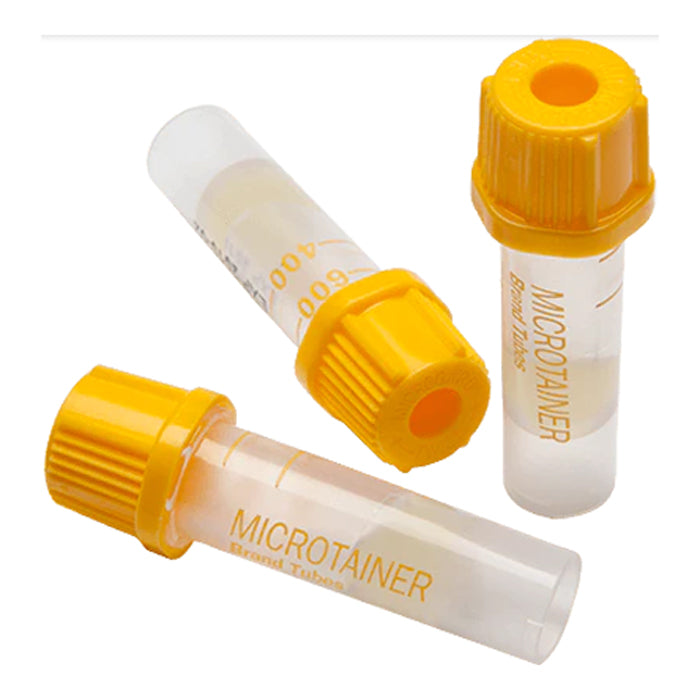
Microtainer SST Capillary Blood Collection Tubes with Serum Separator Additive and Microgard Closure 15.3 x 46mm, 50/box

by BD
Year End Sale 28%
Original price $ 129.95
Current price $ 94.00
SKU 365967

Microtainer SST (Serum Separator Tube) Capillary Blood Collection Tubes with a serum separator additive are designed for collecting small blood samples, typically from a fingerstick or heelstick. These tubes contain a clot activator and a gel that separates serum from the cellular components once centrifuged. They are used for:

  1. Chemistry Tests: Analyzing metabolic functions and organ health.
  2. Serology: Detecting antibodies and antigens.
  3. Endocrinology: Measuring hormone levels.

They're particularly useful in settings like pediatrics or when only a small sample volume is needed, ensuring efficient separation of serum for accurate testing.

Microtainer SST Capillary Blood Collection Tubes with Serum Separator Additive and Microgard Closure are engineered for efficient and accurate capillary blood collection. Ideal for small volume serum testing, these tubes ensure reliable results with minimal discomfort, making them perfect for pediatric and geriatric patients.

Details and Features

  • Dimensions: Compact size at 15.3 x 46mm, facilitating easy handling and storage.
  • Volume Capacity: Designed for volumes from 400 µL to 600 µL, suitable for micro-sampling needs.
  • Serum Separator Additive: A gel additive effectively separates serum from cells, ensuring high-quality samples.
  • Microgard Closure: Provides a secure seal, preventing contamination and leakage.
  • Packaging: Available in boxes of 50, ideal for clinics and labs requiring precise, small-volume collections.

Mechanism of Action

The serum separator additive forms a stable barrier between the serum and blood cells during centrifugation, preventing cell contamination and ensuring the purity of the serum. The Microgard Closure further ensures sample integrity by providing a secure and contamination-free seal.

Directions for Use

  1. Preparation: Prepare the site for capillary puncture and gather all necessary equipment.
  2. Collection: Perform the capillary puncture, collecting blood up to the indicated fill line (400-600 µL).
  3. Mixing: Gently invert the tube 5 times to ensure the blood mixes with the serum separator additive.
  4. Centrifugation: Follow lab protocols to centrifuge the tube, enabling serum separation for analysis.

Warnings

  • Proper Fill: Ensure the tube is filled within the specified volume range to maintain accuracy in results.
  • Handling and Safety: Handle with care to avoid contamination and ensure correct sample identification.
  • Storage Conditions: Store in a cool, dry place, maintaining temperature between 4°C and 25°C.
  • Single Use: These tubes are intended for one-time use. Do not reuse or attempt to sterilize.
  • Expiration Check: Use before the expiration date printed on the packaging to ensure effective performance.

Microtainer SST Capillary Blood Collection Tubes with Serum Separator Additive offer a dependable solution for serum testing in micro-sampling, providing reliable results with high ease of use and safety.

Microtainer SST Capillary Blood Collection Tubes with Serum Separator Additive and Microgard Closure 15.3 x 46mm, 50/box
$ 129.95 $ 94.00
FAQs About Phlebotomy Supplies
  • What Supplies Are Needed for Phlebotomy?

    Phlebotomy needles & butterfly sets (multi-sample, straight, winged infusion) Vacutainer tubes & collection vials Tourniquets Alcohol prep pads & antiseptic wipes Sterile gauze pads & bandages Sharps containers Gloves (nitrile or latex-free) Needle holders/adapters Syringes (for specific collections) Blood culture bottles (as needed) Lab labels and requisitions

  • Is a Phlebotomist Higher than a CNA?

    Phlebotomists and CNAs (Certified Nursing Assistants) have different qualifications: Phlebotomists specialize in blood collection and laboratory testing. CNAs provide basic patient care. Neither is “higher,” but a phlebotomist’s work is more specialized in specimen collection.

  • What's the Hardest Part of Phlebotomy?

    Finding veins in challenging patients (elderly, children, dehydrated) Managing patient anxiety or needle phobia Maintaining infection control & handling biohazards

  • What Are the 7 Duties of a Phlebotomist?

    Preparing phlebotomy supplies and verifying test orders Patient identification and consent Blood collection using proper technique Labeling and documenting blood samples Ensuring patient comfort and post-draw care Maintaining infection control and safety Transporting or processing specimens for laboratory testing

  • How Many Patients Do a Phlebotomist Draw in One Hour?

    Experienced phlebotomists may draw 10–20 patients per hour, depending on patient population and collection complexity.

  • What Shoes Should a Phlebotomist Wear?

    Comfortable, closed-toe, non-slip shoes are required for safety and long shifts in clinical or lab settings.

  • What Is the First Thing a Phlebotomist Should Do?

    Verify the patient’s identity and confirm the blood test order before preparing supplies or starting the draw.

  • Can a Phlebotomist Give Shots?

    Phlebotomists generally do not administer shots/vaccinations. Their role is focused on blood collection, but in some states/countries—additional certification may allow limited injections.

  • What Is the Number One Rule in Phlebotomy?

    Accurate patient identification and labeling is the #1 rule. Failure here is the greatest source of medical errors.

  • What Is the Difference Between a Phlebotomist 1 and 2?

    Phlebotomist 1: Entry-level, basic blood draws, routine collections. Phlebotomist 2: Advanced; may draw pediatric, geriatric, or “difficult stick” patients, process special specimens, train others, or manage supplies.

  • Key Features & Benefits

    Full range of phlebotomy supplies from leading brands (BD, Greiner, McKesson) Sterile, single-use, and safety-engineered devices Phlebotomy carts, trays, and specimen transport tools Bulk pricing, clinic packages, and same-day shipping Supports regulatory compliance and lab best practices

Search Any Type of Product, Medication, or Alignment