












Filters
- Calcium (2)
- calcium cardiac resuscitation (2)
- calcium for hypocalcemia (2)
- Calcium Gluconate (7)
- Calcium Gluconate 1000mg/10mL (2)
- Calcium Gluconate for Injection (6)
- Calcium Gluconate for Injection 1000 mg (1)
- Calcium Injection (2)
- calcium supplement hospital (2)
- doctor-only (7)
- emergency calcium injection (2)
- Fresenius Kabi Calcium Gluconate (2)
- hospital IV calcium (2)
- injectable electrolyte (2)
- IV calcium therapy (2)
- multiple-dose vial (2)
- NDC 63323-0360-61 (2)
- Post-Parathyroidectomy (4)
- Renal Osteodystrophy (4)
- Acute Symptomatic Hypocalcemia (1)
- Bone (1)
- Bone health (1)
- Calcium Deficiencies (1)
- Cell Membranes (1)
- Hyperkalemia (1)
- Magnesium Sulfate Overdose (1)
- Muscle Contraction (1)
- Nerve Function (1)
- 63323-0360-59 (1)
- Calcium Gluconate 500mg (1)
- 1000 mg/10 mL calcium gluconate (1)
- calcium gluconate hospital (1)
- calcium replacement medication (1)
- cardiac arrest calcium (1)
- emergency calcium IV (1)
- IV calcium for hypocalcemia (1)
- NDC 65145-0170-25 (1)
- Preservative Free (1)
- preservative free calcium injection (1)
- single dose calcium gluconate vial (1)
- sterile calcium injection (1)
- Freeflex (1)
- Sodium Chloride Injection (1)
Calcium Gluconate Injection & IV Calcium Gluconate
How to buy prescription items
Rx and license-required products need a verified license on your account. You do this once, and it unlocks every Rx item in the store.
Rx items ship only to a business address, never to a home.
-
1
Create an account or sign in
Verification is stored on your account, so sign in before you start. Guest checkout cannot be used for Rx items.
-
2
Click Verify on the product
Any item that needs a license shows this badge where the Add to Cart button normally sits.
🔒 License required · Verify → -
3
Fill the Rx Apply form
Name, email, license number, NPI number, state, and an upload of your license document. Add your business shipping address too, the clinic, practice or pharmacy where your Rx orders will go. Takes about two minutes.
-
4
Our team reviews it
The badge changes to Under manual review. Most licenses are cleared within 1 business day.
🔎 Under manual review -
5
Buy any Rx item
The badge turns green and Add to Cart unlocks across the whole store. At checkout, ship to your business address.
✓ License verified
-

 Sale 37%
🔒 Medical License Required
Calcium Gluconate Injection 1000 mg per 10 ml Single-Dose 10 mL x 25/Tray (Rx)
Black FridaySave $ 47.50 At checkout$ 427.5037% OFFOriginal price $ 750.00Current price $ 475.00 -

 Sale 45%
🔒 Medical License Required
Calcium Gluconate Injection 1000 mg per 10 mL (100 mg per mL) SDV 10 mL x 10/Pack (Rx)
Black FridaySave $ 23.50 At checkout$ 211.5045% OFFOriginal price $ 425.00Current price $ 235.00 -

 Sale 28%
🔒 Medical License Required
Calcium Gluconate Injection 5000 mg per 50 ml vial Single-Dose vials 50 mL x 25/Tray (Rx)
Black FridaySave $ 89.90 At checkout$ 809.1028% OFFOriginal price $ 1,250.00Current price $ 899.00 -

 Sale 26%
🔒 Medical License Required
Calcium Gluconate Injection 1000 mg Per 10 mL Single Dose Vials, Preserve Free 25/Pack (RX)
Black FridaySave $ 36.50 At checkout$ 328.5026% OFFOriginal price $ 495.95Current price $ 365.00 -
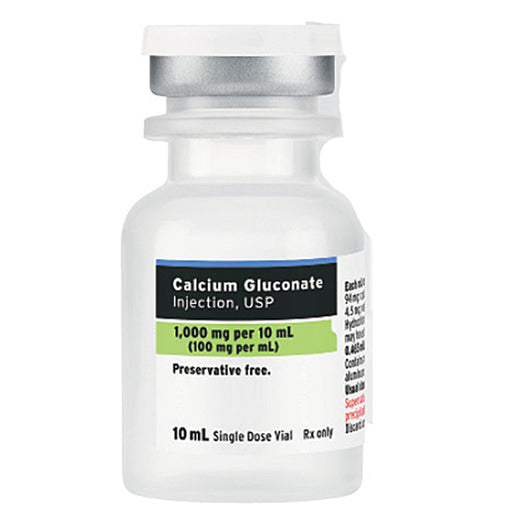 Sale 23%
🔒 Medical License Required
Calcium Gluconate for Injection 1000mg per 10 ml vial Multiple-Dose vials 10 mL x 25/Tray (Rx)
Black FridaySave $ 169.50 At checkout$ 1,525.5023% OFFOriginal price $ 2,195.95Current price $ 1,695.00 -
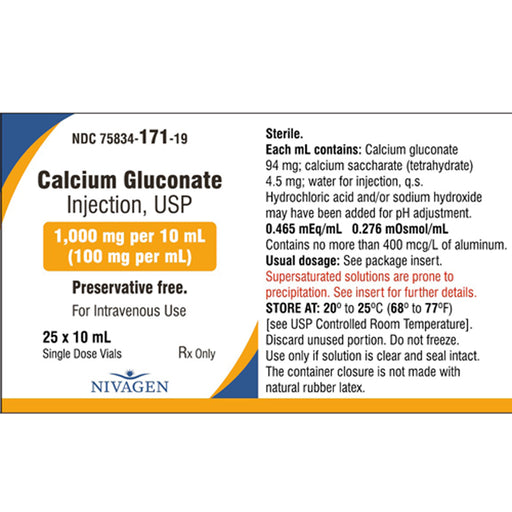 Sale 28%
🔒 Medical License Required
Calcium Gluconate for Injection 1000mg per 10 ml vial Single-Dose vials 10 mL x 25/Tray (Rx)
Black FridaySave $ 51.90 At checkout$ 467.1028% OFFOriginal price $ 725.00Current price $ 519.00 -
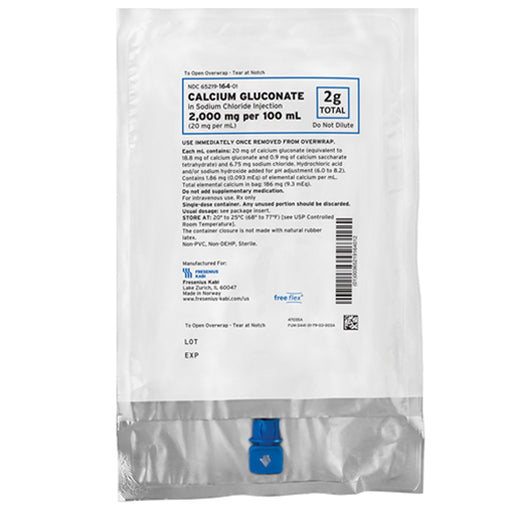 Sale 25%
🔒 Medical License Required
Calcium Gluconate in Sodium Chloride Injection Freeflex 2,000 mg per 100 mL 24/Case (Rx)
Black FridaySave $ 149.50 At checkout$ 1,345.5025% OFFOriginal price $ 1,999.95Current price $ 1,495.00


People Also Searched For
Calcium Gluconate Injection
Calcium gluconate injection is a sterile intravenous calcium supplement. It is commonly supplied as a 10% solution (10 mL vials, containing 1 g calcium gluconate, which provides about 93 mg elemental Ca²⁺). Because calcium gluconate contains much less elemental calcium than calcium chloride, it is a milder form of IV calcium (roughly one‐third the calcium of an equal volume of 10% CaCl₂). Calcium gluconate is used to acutely raise blood calcium and stabilize the heart in certain emergencies. It is the form of IV calcium most often used for hypocalcemia and can be given safely by peripheral IV (unlike CaCl₂, which is very irritating).
Uses
IV calcium gluconate is indicated when rapid calcium correction or cardiac stabilization is needed. Typical emergency uses include:
- Severe hypocalcemia: In life-threatening low calcium (e.g. acute hypoparathyroidism, post-thyroidectomy tetany, massive blood transfusion with citrate toxicity), IV calcium gluconate quickly raises serum Ca²⁺. (For very acute, severe cases, some protocols prefer calcium chloride because it delivers more elemental Ca, but calcium gluconate is often first‐line for IV replacement of calcium.)
- Hyperkalemia: When blood potassium is dangerously high or ECG shows changes (peaked T waves, widened QRS), IV calcium gluconate is given to stabilize cardiac membranes. The extra Ca²⁺ protects the heart from the cardiotoxic effects of hyperkalemia and can temporarily reduce arrhythmia risk.
- Hypermagnesemia: In magnesium overdose (e.g. excessive IV Mg in eclampsia or renal failure), calcium gluconate antagonizes magnesium’s neuromuscular and cardiac depressant effects. It can reverse magnesium-induced hypotension and respiratory depression.
- Other critical uses: Calcium gluconate may also be used in severe calcium-channel blocker overdose or hydrofluoric acid exposure. In fluoride burns, for example, IV (or topical) calcium gluconate binds free fluoride to form CaF₂ and helps prevent systemic hypocalcemia. (Topical 2.5% CaG gel for HF burns is well known; IV CaG is given if fluoride ingestion or signs of systemic toxicity.
Calcium Gluconate Dosage
Calcium gluconate is given by intravenous injection or infusion only. It must not be given by muscle or under the skin. (Indeed, it is “not recommended for injection into a muscle”. It is typically diluted (e.g. 10–30 mL of 10% solution in 50–100 mL IV fluid) and infused slowly over 5–10 minutes. A common adult dose is 1 g (10 mL of 10% solution) IV over several minutes; this can be repeated as needed with monitoring. Some references say up to 1–2 g (10–20 mL) IV, repeated every 10–20 minutes, until calcium levels or ECG normalize. Infusion should be done with cardiac monitoring. Unlike calcium chloride, calcium gluconate is less irritating, so it can often be given via a large peripheral IV. However, care should still be taken: verify good IV placement and monitor the patient during the infusion.
Side Effects
Like all IV calcium salts, calcium gluconate must be used cautiously:
- Administration rate: Too-rapid infusion can cause bradycardia, hypotension, or arrhythmias. Infuse each dose over at least 5 minutes while monitoring the ECG. Patients often feel warmth or a flushing sensation during infusion.
- Injection-site reactions: Calcium gluconate can irritate veins. It often causes infusion-site pain. Extravasation (leakage into tissues) may cause local necrosis, though CaG is less caustic than CaCl₂. Always check IV patency; using a central line is safest if available.
- Hypercalcemia: Do not administer if blood calcium is already high. Overcorrection can lead to hypercalcemia (which can cause confusion, kidney stones, arrhythmias). Calcium levels should be rechecked if multiple doses are given.
- Drug interactions: Avoid mixing calcium solutions with phosphate or bicarbonate-containing IV fluids (precipitation can occur). In patients on digoxin (digitalis), IV calcium can precipitate dangerous arrhythmias, so use extreme caution.
- Other side effects: Rarely, severe reactions can occur. Common transient effects are low blood pressure and slowing of the heartbeat during the infusion.
Calcium gluconate injection is a 10% IV calcium solution used for acute hypocalcemia and to stabilize cardiac conduction in hyperkalemia or hypermagnesemia. It is less concentrated than calcium chloride and is the usual IV calcium of choice when peripheral access is used. Because it is potent and can cause harm if misused, it must be given under medical supervision with appropriate dilution and monitoring