Skip to content

Added to your cart:

Cart subtotal

Insulin Syringes to Semaglutide Syringes

Insulin Syringes

Insulin syringes are specialized medical syringes used by people with diabetes to self-administer insulin injections. They are calibrated in insulin units rather than standard volume units (e.g. milliliters) because insulin dosage is measured in biological “units.” In standard U-100 insulin preparations, 1 mL = 100 units of insulin. This means a 1 mL syringe holds 100 units of U-100 insulin, a 0.5 mL syringe holds 50 units, and a 0.3 mL syringe holds 30 units. (Some medications use U-40 or higher concentrations, but U-100 is now the norm in most countries.) Insulin syringes are designed for subcutaneous (under the skin) injections and have several key features suited to this purpose:

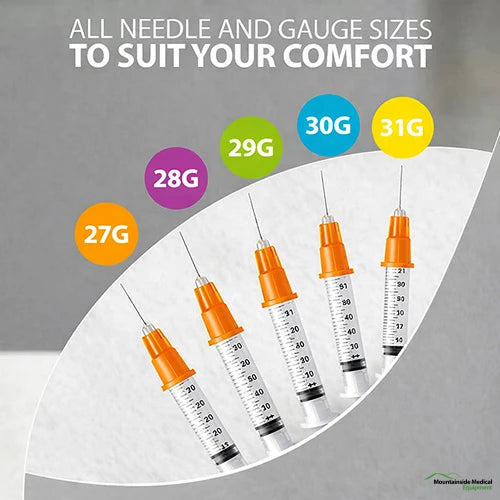
  • Fine, short needles: Insulin syringes use very thin needles (often 28–31 gauge) that are just a few millimeters long. This minimizes pain when injecting under the skin.
  • Unit markings: The syringe barrel is printed in insulin “units” rather than milliliters, so users can dial up the correct dose directly. For U-100 insulin, each “unit” marking corresponds to 0.01 mL.
  • Low dead space: Many insulin syringes have a low dead-space design, which means very little insulin remains wasted in the tip after injection. This ensures accurate dosing and efficiency.
  • Single-use, disposable: Because sterility is critical, insulin syringes are intended for one-time use. Reusing or sharing syringes increases infection risk and is strongly discouraged.

Each insulin syringe is typically sold with a protective cap and sometimes an attached needle or with a separate needle that can be attached. Patients are usually instructed to attach a new sterile needle for each injection. After use, the needle should be capped and placed in a sharps container (see “Safety and Disposal” below).

Common Sizes and Calibrations

Insulin syringes come in several small-volume sizes to match typical insulin doses, each labeled in units of insulin. The most common insulin syringe sizes (U-100) are:

  • 1.0 mL (100 units): Holds a maximum of 100 units. Graduations are usually in 10-unit increments, with each small line often representing 2 units.
  • 0.5 mL (50 units): Holds up to 50 units. Markings are typically 5–10 unit increments; many syringes have 1-unit tick marks for precision.
  • 0.3 mL (30 units): Holds up to 30 units, often used when doses are generally 30 units or less. These usually have markings every 5 units and finer lines for each 1 unit.

Some manufacturers also make half-unit syringes (0.3 mL with 0.5-unit markings) intended for very small doses (common in young children or very insulin-sensitive persons). When choosing a syringe, it’s important to match the syringe size to the insulin concentration (e.g. using U-100 syringes for U-100 insulin) and to pick a syringe that gives good resolution (smaller syringes allow smaller dose increments).

Using Insulin Syringes

Proper injection technique is essential for safe and effective insulin therapy. Each step should follow a healthcare provider’s instructions, but general principles include:

  • Preparation: Wash hands thoroughly. Inspect and gently agitate the insulin vial (if it’s a suspension) to mix the medicine. Draw air into the syringe equal to the dose, inject the air into the vial, then draw up the correct insulin dose into the syringe.
  • Choose and prepare an injection site: Common injection sites are the abdomen (avoiding a 2-inch area around the navel), the front of the thighs, the upper buttocks, and the back or side of the upper arms. Rotate injection sites systematically (e.g. rotating quadrants or days) to avoid repeatedly injecting the exact same spot. This rotation helps prevent lipohypertrophy (fat tissue buildup) which can occur if one site is used too often. Some guidelines recommend cleaning the skin with an alcohol swab before injection, especially if the area is dirty or if recommended by local practice.
  • Injection: Pinch a fold of skin if needed (often needed only if the needle is longer or if the patient is very thin). Insert the needle at a 90° angle to the skin for most modern short needles (some older sources recommend 45° if a long needle is used). Inject the insulin by pushing the plunger slowly and steadily. It is generally not necessary to aspirate (pull back on the plunger) during subcutaneous insulin injections, as blood vessels are unlikely to be punctured; this is a change from older practices.
  • Post-injection: After injecting the insulin, holding the plunger down for a few seconds (typically ~5–10 seconds) before withdrawing the needle can help ensure the full dose is delivered and minimize leaking from the injection site. Then withdraw the needle in the same direction it went in. Gently press the site with gauze (do not rub or massage the site, as that can alter insulin absorption). Finally, safely recap or cover the needle for disposal.

Note: Always follow the specific advice of a healthcare professional or certified diabetes educator for injection technique. Proper technique (site rotation, needle angle, etc.) is crucial for insulin to work predictably. For example, one review notes that correct injection technique and site care are required to ensure insulin’s effectiveness.

Precautions and Safety

  • Sterility and Single Use: Each insulin syringe and needle should be used only once. Even though some people may be tempted to reuse needles for cost reasons, reusing syringes carries infection risks. Studies have shown that bacteria from the skin can enter the syringe and then the bloodstream upon reuse. Modern syringes are designed to be cheap and disposable specifically to reduce infection risk. Never share insulin needles or syringes with another person.
  • Site Inspection: Avoid injecting into areas with skin problems (scars, infected or inflamed areas, or areas that are bruised). Check each chosen site; if there is swelling or lumps (lipohypertrophy), skip that spot and find a new area. Repeated injections into a lump can reduce insulin absorption.
  • Avoiding Air Bubbles: Any air bubble in the syringe will have negligible effect on an insulin dose (because insulin is a suspension), but aim to remove large bubbles when drawing insulin.
  • Accidental Overdose: Be especially careful not to confuse syringes (using a U-100 syringe with U-500 insulin, for example, can cause a 5-fold dosing error!). Always double-check labels. Use only the concentration your provider prescribed.
  • Sharps Disposal: Immediately after use, place the used needle and syringe in a puncture-resistant sharps container. Do not throw used syringes in the regular trash or recycling. Many communities have specific disposal programs (community sharps bins, pharmacy drop-off, mail-back programs, etc.). Proper sharps disposal protects others from accidental needle sticks. (Health authorities generally advise disposing of used needles in an approved sharps container or according to local regulations. See, for example, CDC or local guidelines on household medical waste.)

Comparison to Insulin Pens and Pumps

Insulin syringes are one of several ways to inject insulin (alongside insulin pens and insulin pumps). Compared to pens, syringes require the user to draw up insulin from a vial but have the advantage of fine dose control and no dependence on mechanical dose clicking. Some patients prefer syringes for very small or precise dosing (especially using half-unit syringes). Pens have built-in dosing dials and disposable pen needles (usually similar short gauges, 4–8 mm length). Pumps are computerized infusion devices that deliver rapid or long-acting insulin through a catheter, but those are beyond the scope of syringe discussion. (In any case, all subcutaneous injection methods rely on similar site-rotation and hygiene principles.)

Key Takeaways

  • Insulin syringes are unit-calibrated for insulin (mostly U-100), with fine short needles and minimal dead space.
  • They come in small volumes (0.3, 0.5, 1.0 mL) marked 30, 50, or 100 insulin units; very small-dosage versions have half-unit marks.
  • Use a syringe that matches your insulin concentration (don’t mix U-100 insulin and a U-40 syringe, for example).
  • Follow recommended injection steps: clean hands, draw the correct dose, choose and rotate a suitable site, insert the needle subcutaneously (usually at 90°), inject insulin, then hold and withdraw needle.
  • Always use a new sterile syringe and needle for each injection. Do not reuse or share syringes, as this can introduce infection.
  • Dispose used syringes in a proper sharps container to prevent injury and contamination.

Disclaimer: This information is provided for general knowledge and does not replace personalized instruction by a healthcare provider. Always follow the guidance of medical professionals or certified diabetes educators for your specific insulin regimen and injection technique.

  • Insulin Syringes with Needle U-100, All Size Insulin Needles, EasyTouch 100/Box
    Sale
    $ 17.50

    Insulin Syringes with Needle U-100, All Size Insulin Needles, EasyTouch 100/Box

    MHC

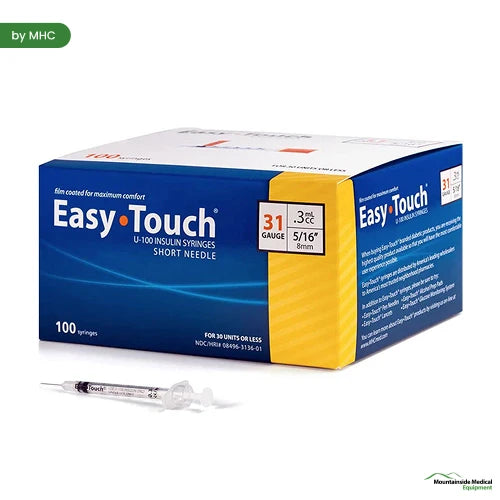
    EasyTouch Insulin Syringes EasyTouch U-100 Syringes are disposable, single-use insulin syringes designed specifically for standard U-100 insulin (1...

    View full details

Insulin Syringes

Insulin syringes are specialized medical syringes used by people with diabetes to self-administer insulin injections. They are calibrated in insulin units rather than standard volume units (e.g. milliliters) because insulin dosage is measured in biological “units.” In standard U-100 insulin preparations, 1 mL = 100 units of insulin. This means a 1 mL syringe holds 100 units of U-100 insulin, a 0.5 mL syringe holds 50 units, and a 0.3 mL syringe holds 30 units. (Some medications use U-40 or higher concentrations, but U-100 is now the norm in most countries.) Insulin syringes are designed for subcutaneous (under the skin) injections and have several key features suited to this purpose:

  • Fine, short needles: Insulin syringes use very thin needles (often 28–31 gauge) that are just a few millimeters long. This minimizes pain when injecting under the skin.
  • Unit markings: The syringe barrel is printed in insulin “units” rather than milliliters, so users can dial up the correct dose directly. For U-100 insulin, each “unit” marking corresponds to 0.01 mL.
  • Low dead space: Many insulin syringes have a low dead-space design, which means very little insulin remains wasted in the tip after injection. This ensures accurate dosing and efficiency.
  • Single-use, disposable: Because sterility is critical, insulin syringes are intended for one-time use. Reusing or sharing syringes increases infection risk and is strongly discouraged.

Each insulin syringe is typically sold with a protective cap and sometimes an attached needle or with a separate needle that can be attached. Patients are usually instructed to attach a new sterile needle for each injection. After use, the needle should be capped and placed in a sharps container (see “Safety and Disposal” below).

Common Sizes and Calibrations

Insulin syringes come in several small-volume sizes to match typical insulin doses, each labeled in units of insulin. The most common insulin syringe sizes (U-100) are:

  • 1.0 mL (100 units): Holds a maximum of 100 units. Graduations are usually in 10-unit increments, with each small line often representing 2 units.
  • 0.5 mL (50 units): Holds up to 50 units. Markings are typically 5–10 unit increments; many syringes have 1-unit tick marks for precision.
  • 0.3 mL (30 units): Holds up to 30 units, often used when doses are generally 30 units or less. These usually have markings every 5 units and finer lines for each 1 unit.

Some manufacturers also make half-unit syringes (0.3 mL with 0.5-unit markings) intended for very small doses (common in young children or very insulin-sensitive persons). When choosing a syringe, it’s important to match the syringe size to the insulin concentration (e.g. using U-100 syringes for U-100 insulin) and to pick a syringe that gives good resolution (smaller syringes allow smaller dose increments).

Using Insulin Syringes

Proper injection technique is essential for safe and effective insulin therapy. Each step should follow a healthcare provider’s instructions, but general principles include:

  • Preparation: Wash hands thoroughly. Inspect and gently agitate the insulin vial (if it’s a suspension) to mix the medicine. Draw air into the syringe equal to the dose, inject the air into the vial, then draw up the correct insulin dose into the syringe.
  • Choose and prepare an injection site: Common injection sites are the abdomen (avoiding a 2-inch area around the navel), the front of the thighs, the upper buttocks, and the back or side of the upper arms. Rotate injection sites systematically (e.g. rotating quadrants or days) to avoid repeatedly injecting the exact same spot. This rotation helps prevent lipohypertrophy (fat tissue buildup) which can occur if one site is used too often. Some guidelines recommend cleaning the skin with an alcohol swab before injection, especially if the area is dirty or if recommended by local practice.
  • Injection: Pinch a fold of skin if needed (often needed only if the needle is longer or if the patient is very thin). Insert the needle at a 90° angle to the skin for most modern short needles (some older sources recommend 45° if a long needle is used). Inject the insulin by pushing the plunger slowly and steadily. It is generally not necessary to aspirate (pull back on the plunger) during subcutaneous insulin injections, as blood vessels are unlikely to be punctured; this is a change from older practices.
  • Post-injection: After injecting the insulin, holding the plunger down for a few seconds (typically ~5–10 seconds) before withdrawing the needle can help ensure the full dose is delivered and minimize leaking from the injection site. Then withdraw the needle in the same direction it went in. Gently press the site with gauze (do not rub or massage the site, as that can alter insulin absorption). Finally, safely recap or cover the needle for disposal.

Note: Always follow the specific advice of a healthcare professional or certified diabetes educator for injection technique. Proper technique (site rotation, needle angle, etc.) is crucial for insulin to work predictably. For example, one review notes that correct injection technique and site care are required to ensure insulin’s effectiveness.

Precautions and Safety

  • Sterility and Single Use: Each insulin syringe and needle should be used only once. Even though some people may be tempted to reuse needles for cost reasons, reusing syringes carries infection risks. Studies have shown that bacteria from the skin can enter the syringe and then the bloodstream upon reuse. Modern syringes are designed to be cheap and disposable specifically to reduce infection risk. Never share insulin needles or syringes with another person.
  • Site Inspection: Avoid injecting into areas with skin problems (scars, infected or inflamed areas, or areas that are bruised). Check each chosen site; if there is swelling or lumps (lipohypertrophy), skip that spot and find a new area. Repeated injections into a lump can reduce insulin absorption.
  • Avoiding Air Bubbles: Any air bubble in the syringe will have negligible effect on an insulin dose (because insulin is a suspension), but aim to remove large bubbles when drawing insulin.
  • Accidental Overdose: Be especially careful not to confuse syringes (using a U-100 syringe with U-500 insulin, for example, can cause a 5-fold dosing error!). Always double-check labels. Use only the concentration your provider prescribed.
  • Sharps Disposal: Immediately after use, place the used needle and syringe in a puncture-resistant sharps container. Do not throw used syringes in the regular trash or recycling. Many communities have specific disposal programs (community sharps bins, pharmacy drop-off, mail-back programs, etc.). Proper sharps disposal protects others from accidental needle sticks. (Health authorities generally advise disposing of used needles in an approved sharps container or according to local regulations. See, for example, CDC or local guidelines on household medical waste.)

Comparison to Insulin Pens and Pumps

Insulin syringes are one of several ways to inject insulin (alongside insulin pens and insulin pumps). Compared to pens, syringes require the user to draw up insulin from a vial but have the advantage of fine dose control and no dependence on mechanical dose clicking. Some patients prefer syringes for very small or precise dosing (especially using half-unit syringes). Pens have built-in dosing dials and disposable pen needles (usually similar short gauges, 4–8 mm length). Pumps are computerized infusion devices that deliver rapid or long-acting insulin through a catheter, but those are beyond the scope of syringe discussion. (In any case, all subcutaneous injection methods rely on similar site-rotation and hygiene principles.)

Key Takeaways

  • Insulin syringes are unit-calibrated for insulin (mostly U-100), with fine short needles and minimal dead space.
  • They come in small volumes (0.3, 0.5, 1.0 mL) marked 30, 50, or 100 insulin units; very small-dosage versions have half-unit marks.
  • Use a syringe that matches your insulin concentration (don’t mix U-100 insulin and a U-40 syringe, for example).
  • Follow recommended injection steps: clean hands, draw the correct dose, choose and rotate a suitable site, insert the needle subcutaneously (usually at 90°), inject insulin, then hold and withdraw needle.
  • Always use a new sterile syringe and needle for each injection. Do not reuse or share syringes, as this can introduce infection.
  • Dispose used syringes in a proper sharps container to prevent injury and contamination.

Disclaimer: This information is provided for general knowledge and does not replace personalized instruction by a healthcare provider. Always follow the guidance of medical professionals or certified diabetes educators for your specific insulin regimen and injection technique.

Get Notified When Back in Stock