



Nasal Cannulas for O2 Cannula
-
 Sale 46%
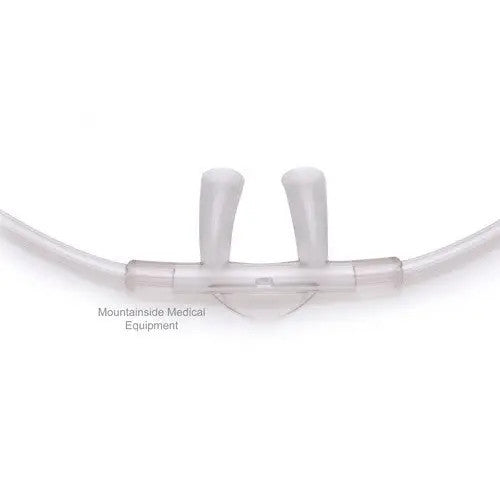
Nasal Cannula with Curved Nasal Prongs with 7 Foot Tubing
Original price $ 2.35Current price $ 1.28

Nasal Cannulas
A nasal cannula is a lightweight medical device for delivering supplemental oxygen. It is essentially a thin, soft plastic tube that loops around the patient’s head and ends in two prongs placed just inside the nostrils. The other end of the tube attaches to an oxygen source (cylinder or concentrator) to provide a steady O₂ flow. Standard low-flow cannulas typically supply about 1–6 liters/minute of oxygen, yielding roughly 24–44% inspired O₂ at the higher flows.. (Above ~6 L/min, nasal passages dry out without humidification.) In contrast, high-flow nasal cannula (HFNC) systems heat and humidify the gas and can deliver much higher flows – up to ~60 L/min at nearly 100% O₂ concentration.
-
Structure & flow: A nasal cannula is a single clear plastic tube with two short nasal prongs. It is placed with the tubing behind the ears and the prongs resting in the nostrils. Oxygen flow is prescribed by a regulator. At low flows (1–6 L/min), the cannula provides modest oxygen enrichment (about 24–44% FiO₂). High-flow versions (HFNC) introduce warmed, humidified oxygen, allowing flow rates up to ~60 L/min with FiO₂ up to 100%.
-
Common uses: Nasal cannulas are used whenever patients need supplemental oxygen but not full ventilatory support. They treat hypoxemia in many conditions: chronic lung diseases (COPD, bronchitis, asthma, cystic fibrosis), pneumonia or ARDS, heart failure (pulmonary edema), and similar respiratory insufficiency. They are used both in hospitals (ER, wards, ICU for oxygen therapy) and at home for long-term oxygen support. For example, COPD patients may use concentrators with a cannula for ambulation, while newborns or post-surgical patients may use small cannulas for mild oxygen needs. (During COVID-19, high-flow cannulas in ICUs often helped avoid intubation and lowered mortality.)
-
Advantages: Nasal cannulas are comfortable and non-obtrusive. Patients can talk, eat, and drink normally because the device does not cover the mouth. They are easy to apply and ideal for ambulatory or home oxygen therapy. Low equipment cost and simple care (changing the cannula weekly) make them practical for chronic oxygen use.
-
Limitations and precautions: Cannulas are low-flow devices. They cannot provide very high FiO₂ (max ~0.44 at 6 L/min), so patients needing >50–60% O₂ usually require masks (Venturi or non-rebreather) or ventilators. Prolonged nasal cannula use can cause nasal dryness or irritation if the gas is not humidified. (Heated humidifiers or electrolyte nasal sprays are often used to mitigate this.) Oxygen itself is highly flammable, so cannulas (like all O₂ therapy) require no smoking or open flames nearby. Excessive oxygen can also harm the lungs (oxygen toxicity) if FiO₂ is too high for too long.
Key Takeaways: Nasal cannulas are simple O₂-delivery tubes with two nasal prongs, used for mild-to-moderate respiratory support. They deliver low-flow oxygen (commonly 1–6 L/min, raising FiO₂ to ~24–44%); heated high-flow cannula systems (HFNC) extend this up to ~60 L/min and near-100% O₂. Cannulas are widely used in hospital and home settings to treat conditions like COPD, pneumonia, heart failure, sleep apnea, and during patient recovery. Advantages include patient comfort (can talk and eat); disadvantages include nasal drying and limited FiO₂ delivery. Overall, nasal cannulas are a foundational respiratory support tool for patients who need supplemental oxygen but not mechanical ventilation.
Oxygen Flow and Use: A standard nasal cannula typically delivers oxygen at low flow rates, generally between 1 to 6 liters of oxygen per minute (L/min).
-
At 1–2 L/min, you get a small boost of oxygen (often used for people who need just a bit of help, such as some COPD patients at rest).
-
At higher flows like 4–6 L/min, more oxygen is provided. However, standard nasal cannulas usually aren’t used much above 5–6 L/min because at higher flows the oxygen can feel dry or irritating to the nasal passages and the percentage of oxygen delivered (FiO₂) plateaus (meaning you don’t get a much higher oxygen concentration due to room air mixing with it). Often, if someone needs more oxygen than a standard cannula can provide, a face mask or a specialized high-flow cannula is used.
-
Oxygen coming through a nasal cannula can be humidified (moistened) especially at flows above 2–3 L/min, to prevent dryness in the nose. In hospitals, you’ll often see a sterile water bubbler attached to the oxygen source for this purpose.
A nasal cannula is a simple and commonly used device for oxygen therapy, consisting of a lightweight tube with two prongs that sit at the nostrils. It’s used to deliver extra oxygen to people who need it, in a comfortable way that still allows them to talk, eat, and move around. It’s typically used for mild to moderate oxygen needs, at flow rates up to about 5–6 L/min, providing an effective means to improve oxygenation for patients with lung or heart conditions, or anyone temporarily needing a little help with their oxygen intake.