
Fat Emulsion IV Bags
Fat Emulsion IV Bags
Fat Emulsion IV bags are sterile intravenous lipid emulsions used in parenteral nutrition. They provide a concentrated source of calories (energy) and essential fatty acids for patients who cannot eat or absorb fat normally. These emulsions mimic the chylomicrons of dietary fat by suspending oil droplets in water, allowing fat to be safely infused into the bloodstream.
Composition: These IV bags typically contain vegetable oil (most commonly refined soybean oil) as the fat source, along with an emulsifier and stabilizers. For example, a 20% Intralipid® fat emulsion (widely used clinically) contains per 100 mL: 20 g of soybean oil, 1.2 g egg-yolk phospholipids (lecithin, which stabilizes the emulsion), ~2.5 g glycerin (to make the solution isotonic), and a small amount of sodium oleate. This formulation yields about 2.0 kcal per mL (because 20 g fat ~ 180 kcal). (By contrast, a 10% emulsion provides ~1.1 kcal/mL). Newer lipid emulsions may blend other oils (e.g. olive oil, fish oil, medium-chain triglycerides) for different fatty acid profiles, but their role is the same: to supply high-calorie fat and essential fatty acids intravenously.
Uses and Indications: Fat emulsion IV bags are an integral component of Total Parenteral Nutrition (TPN). They are indicated “as a source of calories and essential fatty acids” for patients who require long-term IV feeding (typically >5 days) and cannot take in adequate fat orally or enterally. pecific situations include:
- Prolonged TPN support: Patients receiving intravenous nutrition for extended periods (e.g. critically ill ICU patients, malnourished inpatients) need fat emulsions to meet caloric goals and prevent essential fatty acid deficiency.
- Surgical/Gastrointestinal conditions: Those recovering from major surgery or with severe GI disorders (e.g. Crohn’s disease, bowel obstruction/resection, pancreatitis) who cannot eat normally are given fat emulsions to supply energy and help maintain nutrition.
- Burns, trauma, cachexia: Patients with severe burns, traumatic injuries, or cancer cachexia have high metabolic needs; IV fat provides a dense energy source to preserve protein and aid healing.
- Other indications: Situations like prolonged unconsciousness or hypermetabolic states where enteral feeding is impossible; or known essential fatty acid deficiency (EFAD) – the fat emulsion prevents EFAD by delivering essential fats.
In summary, fat IV emulsions are used anytime patients need extra calories/fat via IV (for example in TPN regimens), and when providing essential oils that the body cannot make.
Administration and Precautions: Fat emulsions are administered slowly by IV infusion (often via an infusion pump and special filter). They are typically infused over several hours (e.g. 12–24 hours) as part of a TPN regimen. Infusion rate is controlled carefully; for example, guidelines note not exceeding about 1 g fat per kg body weight per 4 hours to avoid fat overload. Triglyceride levels are monitored to gauge tolerance. Clinically, 20% emulsions (2 kcal/mL) allow delivering more calories in smaller volumes.
Precautions include ensuring no hypersensitivity: because these emulsions contain egg phospholipids and soy oil, they are contraindicated in patients with egg or soybean allergy. Fat IVs should be held or slowed if the patient develops signs of fat overload (e.g. high triglycerides, fever, difficulty breathing). Other lipid emulsions (like fish oil-based Omegaven) may be used if soybean allergy is a concern. Under proper monitoring and dosing, side effects are uncommon.
Examples: Common fat emulsion products include Intralipid® (soybean oil emulsion), ClinOleic® (soybean/olive oil blend), SMOFlipid® (soybean, MCT, olive, fish oil), and Omegaven® (pure fish oil emulsion) – all formulated to the strengths above. These are supplied in IV bags (e.g. 10% or 20% lipid concentrations) for infusion by medical providers. In all cases, they serve as a high-energy nutritional supplement in parenteral nutrition.
Fat Emulsion IV Bags – Types, Brands, Dosages and Sizes
Fat emulsion IV bags (also called intravenous lipid emulsions) are sterile, oil-in-water lipid suspensions given intravenously as part of parenteral nutrition. They supply high-energy fat (triglycerides) and essential fatty acids when patients cannot eat or absorb fat by mouth. Fat emulsions are typically available in 10% or 20% concentrations (w/v), where 20% means 20 g of fat per 100 mL (≈2 kcal/mL). Mixed oils are emulsified with egg-phospholipid lecithin as the emulsifier, yielding particles (“fat droplets”) similar to chylomicrons. These products are key for providing concentrated calories and essential omega-3/omega-6 fats in long-term IV nutrition.
Formulations and Brands
Soybean-oil emulsions: The classic IV lipid is pure soybean oil. Intralipid® (Fresenius Kabi) and Nutrilipid® (B. Braun) are 20% soybean oil emulsions. Each 100 mL typically contains 20 g soybean oil, 1.2–1.5 g egg lecithin, ~2.5 g glycerin (for isotonicity) and trace sodium oleate. (These contain essentially no other oils.) Because soybean oil is rich in linoleic acid (omega-6), these emulsions have high phytosterol content and relatively low vitamin E. In practice, 20% emulsions deliver ~2 kcal/mL. (A 10% soybean emulsion also exists – for example, Intralipid 10% – providing ~1.1 kcal/mL.)
Mixed-oil emulsions: Newer IV lipids blend oils to alter fatty acid profiles. For example, ClinOleic® 20% (Baxter) contains 80% olive oil + 20% soybean oil (by weight). Another is SMOFlipid® 20% (Fresenius Kabi), a four-oil mix: 30% soybean oil, 30% medium-chain triglycerides (MCT), 25% olive oil, 15% fish oil. These mixed emulsions aim to reduce omega-6 load and add omega-3 and monounsaturated fats (olive and fish oils) for potential metabolic benefits. In all cases the emulsion is 20% total oil (20 g fat per 100 mL).
Pure fish-oil emulsion: A special product is Omegaven® 10% (Fresenius Kabi), an emulsion of pure fish oil. Each 100 mL contains 10 g fish oil (rich in omega-3 EPA/DHA) and no other oil. It provides 1 kcal/mL (since 10% concentration) and is FDA-approved for pediatric use to prevent/treat parenteral nutrition-associated liver disease. Because it lacks omega-6 fats, Omegaven is usually co-administered with another lipid or used short-term.
In summary, common IV fat emulsion options include 10% vs 20% concentrations, and different oil sources: soybean-based (Intralipid/Nutrilipid), olive/soy mixes (ClinOleic), multifloric blends (SMOFlipid), and fish-oil only (Omegaven). All contain emulsifiers (egg lecithin) and glycerin to stabilize the solution. The color of the emulsion is typically white or milky.
Dosage and Administration
Fat emulsion bags are infused by IV, usually through a Y-site with other parenteral solutions (carbohydrate/amino-acid bags). Typical dosing is weight- and goal-dependent. For stable adults, a common starting rate is ≈1 g fat per kg body weight per day, which for a 20% emulsion equals about 0.2 mL/kg/hr (since 1 g fat = 5 mL of 20% emulsion). Slow infusion initially (e.g. 0.2 mL/kg/hr, or 0.2 g/kg/hr) for the first 10–15 min and then increase to the target rate is recommended. Critically ill adults may start even lower (≤1 g/kg/day). The maximum recommended is roughly 2–2.5 g/kg/day (not exceeding ~500 mL/day of a 20% product). In practice, an upper limit around 150 g of fat per day (about 750 mL of 20% emulsion) is advised for most adults. Serum triglycerides should be monitored; infusion is slowed if levels rise too high.
Pediatric dosing differs. Term infants may receive up to ~2.5–3 g/kg/day; older children 1–2.5 g/kg/day according to needs. For example, infants often start at 0.5–1 g/kg/day and advance, whereas children 1–10 y often use 2–2.5 g/kg/day, adolescents 1–2 g/kg/day. (In neonatal intensive care, 20% fat is often infused as part of TPN, with separate 1,2,3 g/kg/day increments.) As with adults, infusion rates must be slow and controlled via pump (e.g. not exceeding ~0.15-0.2 g/kg/hr initially) and limited over 24 hours (many labels say “infuse over 12–24 h”). Fat emulsions are usually a separate bag or Y-siphoned into the PN line.
Important: These lipid bags should not be given faster than recommended (to avoid fat overload syndrome). For example, guidelines suggest not exceeding ~0.11 g/kg/h (≈0.5 mL/kg/h of 20%) and limiting total daily volume, especially on day 1. Typical dosing systems are grams of fat per kg per day. (For reference, 100 mL of 20% emulsion contains 20 g of fat.)
Special situations: Patients with hypertriglyceridemia or fat allergy (egg/soy) require modified approaches. All formulations contain egg lecithin and soy oil, so egg and soy allergies are contraindications. Omegaven, being fish oil–only, is used in infants with liver disease (often at a fixed dose of 1 g/kg/day of 10% oil). In patients with essential fatty acid deficiency (rare if fat is used in any clinical PN), a minimal fat intake (~0.2–0.4 g/kg/day) is sufficient.
Brands and Bag Sizes
Several commercial IV lipid products are available:
- Intralipid® (20%) – Baxter’s original soybean oil emulsion (20 g/100 mL). Supplied in glass bottles or plastic bags (e.g. 500 mL and 1000 mL). A 10% Intralipid is also sold in smaller bags (e.g. 250 mL) for neonatal use.
- Nutrilipid® 20% – B. Braun’s 20% soybean oil emulsion (composition same as Intralipid). Comes in 250 mL, 500 mL, and 1000 mL flexible containers (PVC-free).
- ClinOleic® 20% – Baxter’s 80% olive oil/20% soy oil emulsion (20 g/100 mL). Available in 500 mL and 1000 mL containers. (A 10% formulation is also marketed in some countries.)
- SMOFlipid® 20% – Fresenius-Kabi’s 4-oil blend (30:30:25:15 soybean:MCT:olive:fish). Comes in 100 mL and 250 mL 20% bags.
- Omegaven® 10% – Fresenius-Kabi’s fish oil–only emulsion (10 g/100 mL). Supplied typically in 100 mL ampules or bags for pediatric use (100 mL is common).
Other emulsions exist (e.g. Liposyn® – Hospira’s soybean oil product; Lipofundin®, Structolipid® – older formulations), but above are the main brands. In general, fat emulsion bags are plastic (non-PVC) containers often labeled “lipid injectable emulsion,” in concentrations of 10% or 20%. Common sizes range from 100 mL (for small-volume pediatric dosing) to 250 mL, 500 mL, and even 1000 mL (for adult TPN) bottles or bags. The bag is shaken gently before use to re-suspend the fat.
Summary: IV fat emulsions are 10% or 20% lipid solutions used in parenteral nutrition as concentrated calorie and essential fat sources. Major types include pure soybean oil emulsions (Intralipid™, Nutrilipid™), olive-oil blends (ClinOleic™), and mixed formulations (SMOFlipid™, Omegaven™). Typical dosing is in grams of fat per kilogram per day (roughly 1–2.5 g/kg/day for adults, higher in infants). They come in various bag sizes (100–1000 mL) and brands, each standardized by concentration and oil composition.
-
 Sale 24%
Original price $ 850.00Current price $ 649.95
Sale 24%
Original price $ 850.00Current price $ 649.95IV Bags, Intralipid 20% Lipid Injectable Emulsion for Intravenous Use 1000 mL x 6/Case (RX)
Fresenius KabiIntralipid 20% Lipid Injectable Emulsion IV Bags (1000 mL) are used for providing a source of calories and essential fatty acids to patients requir...
View full details -
 Sale 39%
Original price $ 895.95Current price $ 545.00
Sale 39%
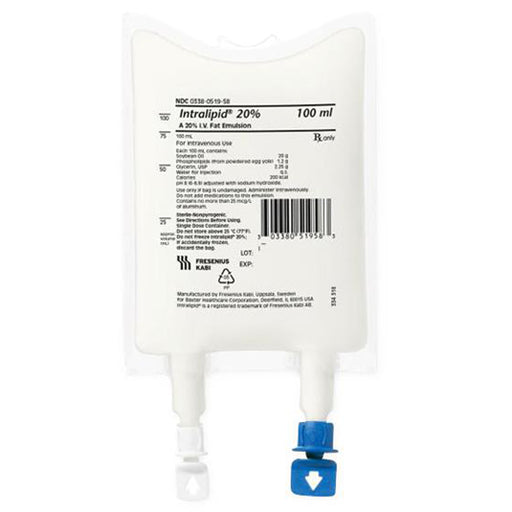
Original price $ 895.95Current price $ 545.00IV Bags, Intralipid 20% IV Fat Emulsion 100 mL IV Bags, 10/Case
Baxter IV SystemsDeliver essential calories and fatty acids with confidence using Intralipid 20% IV Fat Emulsion 100 mL IV Bags—the trusted choice of hospitals, cli...
View full details -
 Sale 9%
Original price $ 599.95Current price $ 545.00
Sale 9%
Original price $ 599.95Current price $ 545.00IV Bags, Intralipid 20% Lipid Injectable Emulsion for Intravenous Use 100 mL x 10/Case (RX)
Fresenius KabiIntralipid (Lipid Injectable Emulsion) by Fresenius Kabi is a premier intravenous nutrition solution, providing an essential source of calories and...
View full details


Fat Emulsion IV Bags
Fat Emulsion IV bags are sterile intravenous lipid emulsions used in parenteral nutrition. They provide a concentrated source of calories (energy) and essential fatty acids for patients who cannot eat or absorb fat normally. These emulsions mimic the chylomicrons of dietary fat by suspending oil droplets in water, allowing fat to be safely infused into the bloodstream.
Composition: These IV bags typically contain vegetable oil (most commonly refined soybean oil) as the fat source, along with an emulsifier and stabilizers. For example, a 20% Intralipid® fat emulsion (widely used clinically) contains per 100 mL: 20 g of soybean oil, 1.2 g egg-yolk phospholipids (lecithin, which stabilizes the emulsion), ~2.5 g glycerin (to make the solution isotonic), and a small amount of sodium oleate. This formulation yields about 2.0 kcal per mL (because 20 g fat ~ 180 kcal). (By contrast, a 10% emulsion provides ~1.1 kcal/mL). Newer lipid emulsions may blend other oils (e.g. olive oil, fish oil, medium-chain triglycerides) for different fatty acid profiles, but their role is the same: to supply high-calorie fat and essential fatty acids intravenously.
Uses and Indications: Fat emulsion IV bags are an integral component of Total Parenteral Nutrition (TPN). They are indicated “as a source of calories and essential fatty acids” for patients who require long-term IV feeding (typically >5 days) and cannot take in adequate fat orally or enterally. pecific situations include:
- Prolonged TPN support: Patients receiving intravenous nutrition for extended periods (e.g. critically ill ICU patients, malnourished inpatients) need fat emulsions to meet caloric goals and prevent essential fatty acid deficiency.
- Surgical/Gastrointestinal conditions: Those recovering from major surgery or with severe GI disorders (e.g. Crohn’s disease, bowel obstruction/resection, pancreatitis) who cannot eat normally are given fat emulsions to supply energy and help maintain nutrition.
- Burns, trauma, cachexia: Patients with severe burns, traumatic injuries, or cancer cachexia have high metabolic needs; IV fat provides a dense energy source to preserve protein and aid healing.
- Other indications: Situations like prolonged unconsciousness or hypermetabolic states where enteral feeding is impossible; or known essential fatty acid deficiency (EFAD) – the fat emulsion prevents EFAD by delivering essential fats.
In summary, fat IV emulsions are used anytime patients need extra calories/fat via IV (for example in TPN regimens), and when providing essential oils that the body cannot make.
Administration and Precautions: Fat emulsions are administered slowly by IV infusion (often via an infusion pump and special filter). They are typically infused over several hours (e.g. 12–24 hours) as part of a TPN regimen. Infusion rate is controlled carefully; for example, guidelines note not exceeding about 1 g fat per kg body weight per 4 hours to avoid fat overload. Triglyceride levels are monitored to gauge tolerance. Clinically, 20% emulsions (2 kcal/mL) allow delivering more calories in smaller volumes.
Precautions include ensuring no hypersensitivity: because these emulsions contain egg phospholipids and soy oil, they are contraindicated in patients with egg or soybean allergy. Fat IVs should be held or slowed if the patient develops signs of fat overload (e.g. high triglycerides, fever, difficulty breathing). Other lipid emulsions (like fish oil-based Omegaven) may be used if soybean allergy is a concern. Under proper monitoring and dosing, side effects are uncommon.
Examples: Common fat emulsion products include Intralipid® (soybean oil emulsion), ClinOleic® (soybean/olive oil blend), SMOFlipid® (soybean, MCT, olive, fish oil), and Omegaven® (pure fish oil emulsion) – all formulated to the strengths above. These are supplied in IV bags (e.g. 10% or 20% lipid concentrations) for infusion by medical providers. In all cases, they serve as a high-energy nutritional supplement in parenteral nutrition.
Fat Emulsion IV Bags – Types, Brands, Dosages and Sizes
Fat emulsion IV bags (also called intravenous lipid emulsions) are sterile, oil-in-water lipid suspensions given intravenously as part of parenteral nutrition. They supply high-energy fat (triglycerides) and essential fatty acids when patients cannot eat or absorb fat by mouth. Fat emulsions are typically available in 10% or 20% concentrations (w/v), where 20% means 20 g of fat per 100 mL (≈2 kcal/mL). Mixed oils are emulsified with egg-phospholipid lecithin as the emulsifier, yielding particles (“fat droplets”) similar to chylomicrons. These products are key for providing concentrated calories and essential omega-3/omega-6 fats in long-term IV nutrition.
Formulations and Brands
Soybean-oil emulsions: The classic IV lipid is pure soybean oil. Intralipid® (Fresenius Kabi) and Nutrilipid® (B. Braun) are 20% soybean oil emulsions. Each 100 mL typically contains 20 g soybean oil, 1.2–1.5 g egg lecithin, ~2.5 g glycerin (for isotonicity) and trace sodium oleate. (These contain essentially no other oils.) Because soybean oil is rich in linoleic acid (omega-6), these emulsions have high phytosterol content and relatively low vitamin E. In practice, 20% emulsions deliver ~2 kcal/mL. (A 10% soybean emulsion also exists – for example, Intralipid 10% – providing ~1.1 kcal/mL.)
Mixed-oil emulsions: Newer IV lipids blend oils to alter fatty acid profiles. For example, ClinOleic® 20% (Baxter) contains 80% olive oil + 20% soybean oil (by weight). Another is SMOFlipid® 20% (Fresenius Kabi), a four-oil mix: 30% soybean oil, 30% medium-chain triglycerides (MCT), 25% olive oil, 15% fish oil. These mixed emulsions aim to reduce omega-6 load and add omega-3 and monounsaturated fats (olive and fish oils) for potential metabolic benefits. In all cases the emulsion is 20% total oil (20 g fat per 100 mL).
Pure fish-oil emulsion: A special product is Omegaven® 10% (Fresenius Kabi), an emulsion of pure fish oil. Each 100 mL contains 10 g fish oil (rich in omega-3 EPA/DHA) and no other oil. It provides 1 kcal/mL (since 10% concentration) and is FDA-approved for pediatric use to prevent/treat parenteral nutrition-associated liver disease. Because it lacks omega-6 fats, Omegaven is usually co-administered with another lipid or used short-term.
In summary, common IV fat emulsion options include 10% vs 20% concentrations, and different oil sources: soybean-based (Intralipid/Nutrilipid), olive/soy mixes (ClinOleic), multifloric blends (SMOFlipid), and fish-oil only (Omegaven). All contain emulsifiers (egg lecithin) and glycerin to stabilize the solution. The color of the emulsion is typically white or milky.
Dosage and Administration
Fat emulsion bags are infused by IV, usually through a Y-site with other parenteral solutions (carbohydrate/amino-acid bags). Typical dosing is weight- and goal-dependent. For stable adults, a common starting rate is ≈1 g fat per kg body weight per day, which for a 20% emulsion equals about 0.2 mL/kg/hr (since 1 g fat = 5 mL of 20% emulsion). Slow infusion initially (e.g. 0.2 mL/kg/hr, or 0.2 g/kg/hr) for the first 10–15 min and then increase to the target rate is recommended. Critically ill adults may start even lower (≤1 g/kg/day). The maximum recommended is roughly 2–2.5 g/kg/day (not exceeding ~500 mL/day of a 20% product). In practice, an upper limit around 150 g of fat per day (about 750 mL of 20% emulsion) is advised for most adults. Serum triglycerides should be monitored; infusion is slowed if levels rise too high.
Pediatric dosing differs. Term infants may receive up to ~2.5–3 g/kg/day; older children 1–2.5 g/kg/day according to needs. For example, infants often start at 0.5–1 g/kg/day and advance, whereas children 1–10 y often use 2–2.5 g/kg/day, adolescents 1–2 g/kg/day. (In neonatal intensive care, 20% fat is often infused as part of TPN, with separate 1,2,3 g/kg/day increments.) As with adults, infusion rates must be slow and controlled via pump (e.g. not exceeding ~0.15-0.2 g/kg/hr initially) and limited over 24 hours (many labels say “infuse over 12–24 h”). Fat emulsions are usually a separate bag or Y-siphoned into the PN line.
Important: These lipid bags should not be given faster than recommended (to avoid fat overload syndrome). For example, guidelines suggest not exceeding ~0.11 g/kg/h (≈0.5 mL/kg/h of 20%) and limiting total daily volume, especially on day 1. Typical dosing systems are grams of fat per kg per day. (For reference, 100 mL of 20% emulsion contains 20 g of fat.)
Special situations: Patients with hypertriglyceridemia or fat allergy (egg/soy) require modified approaches. All formulations contain egg lecithin and soy oil, so egg and soy allergies are contraindications. Omegaven, being fish oil–only, is used in infants with liver disease (often at a fixed dose of 1 g/kg/day of 10% oil). In patients with essential fatty acid deficiency (rare if fat is used in any clinical PN), a minimal fat intake (~0.2–0.4 g/kg/day) is sufficient.
Brands and Bag Sizes
Several commercial IV lipid products are available:
- Intralipid® (20%) – Baxter’s original soybean oil emulsion (20 g/100 mL). Supplied in glass bottles or plastic bags (e.g. 500 mL and 1000 mL). A 10% Intralipid is also sold in smaller bags (e.g. 250 mL) for neonatal use.
- Nutrilipid® 20% – B. Braun’s 20% soybean oil emulsion (composition same as Intralipid). Comes in 250 mL, 500 mL, and 1000 mL flexible containers (PVC-free).
- ClinOleic® 20% – Baxter’s 80% olive oil/20% soy oil emulsion (20 g/100 mL). Available in 500 mL and 1000 mL containers. (A 10% formulation is also marketed in some countries.)
- SMOFlipid® 20% – Fresenius-Kabi’s 4-oil blend (30:30:25:15 soybean:MCT:olive:fish). Comes in 100 mL and 250 mL 20% bags.
- Omegaven® 10% – Fresenius-Kabi’s fish oil–only emulsion (10 g/100 mL). Supplied typically in 100 mL ampules or bags for pediatric use (100 mL is common).
Other emulsions exist (e.g. Liposyn® – Hospira’s soybean oil product; Lipofundin®, Structolipid® – older formulations), but above are the main brands. In general, fat emulsion bags are plastic (non-PVC) containers often labeled “lipid injectable emulsion,” in concentrations of 10% or 20%. Common sizes range from 100 mL (for small-volume pediatric dosing) to 250 mL, 500 mL, and even 1000 mL (for adult TPN) bottles or bags. The bag is shaken gently before use to re-suspend the fat.
Summary: IV fat emulsions are 10% or 20% lipid solutions used in parenteral nutrition as concentrated calorie and essential fat sources. Major types include pure soybean oil emulsions (Intralipid™, Nutrilipid™), olive-oil blends (ClinOleic™), and mixed formulations (SMOFlipid™, Omegaven™). Typical dosing is in grams of fat per kilogram per day (roughly 1–2.5 g/kg/day for adults, higher in infants). They come in various bag sizes (100–1000 mL) and brands, each standardized by concentration and oil composition.