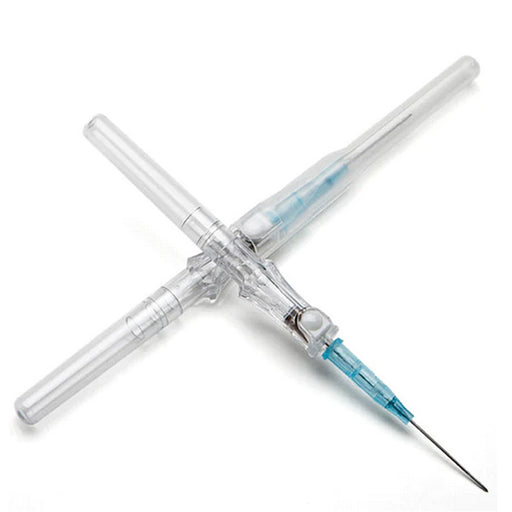
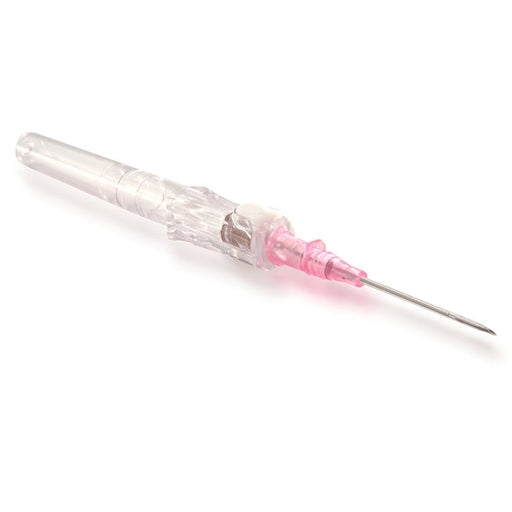
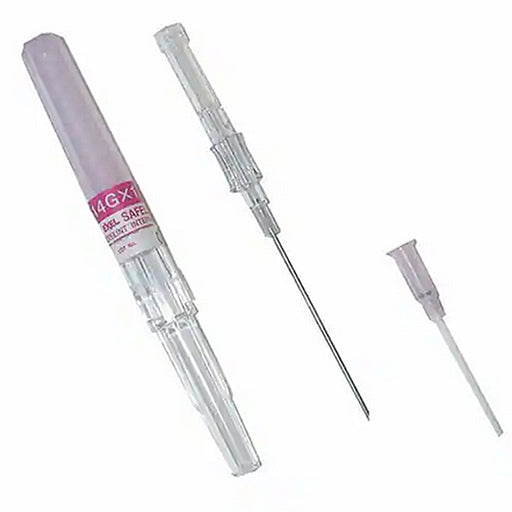
BD Insyte Autoguard™ BC Shielded IV Catheter
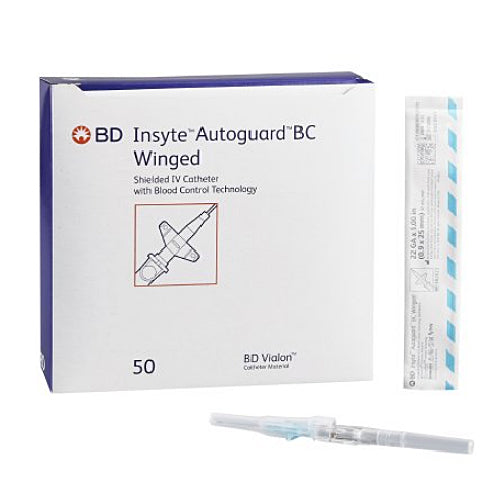
The BD Insyte Autoguard™ BC is a shielded safety peripheral IV catheter with built-in “Blood Control” technology. It is designed to protect healthcare workers from needlestick injuries and blood exposure during routine IV placement. The catheter and needle are made of BD’s proprietary Vialon polymer, which softens in the vein for easier insertion and longer dwell time. A spring-loaded push-button mechanism allows the clinician to retract the metal needle into a protective barrel as soon as flashback is seen. This one-handed safety activation (“Autoguard”) occurs only when the user chooses to press the button, covering the sharp tip immediately. The device also integrates BD Instaflash™ technology – a notched needle that gives an instant blood “flash” in the chamber – so the operator knows exactly when the vein has been entered.
Importantly, the Autoguard BC’s blood-control valve stops the flow of blood out of the catheter hub until the IV tubing or syringe is attached. This means there is virtually no ding of blood during needle removal. In fact, BD reports that this “Blood Control” design yields about a 95% reduction in blood exposure risk compared to standard IVs and in clinical trials 98% of nurses using it felt no blood contact during insertion. In practice, inserting the Autoguard BC catheter is similar to any IV: you prep the skin aseptically, apply a tourniquet, insert the needle/cannula bevel-up at a shallow angle, and look for flashback. Once flash is seen (via the Instaflash window), advance the catheter slightly, then press the Autoguard button. The needle spring-retracts into the hub, and you can immediately connect a saline flush to test patency. The built-in blood-control valve prevents any gush of blood as soon as the needle is pulled back. Finally, secure the catheter (wings or stabilizer) to the skin and label it as usual. (Standard IV care – e.g. chlorhexidine skin prep and hand hygiene – should always be followed.)
Sizes (Gauges and Lengths)
BD Insyte Autoguard BC catheters come in the typical peripheral IV gauges and lengths. Available sizes include:
-
16G (Gray): length 1.16″ or 1.77″ (winged or straight)
-
18G (Green): length 1.16″ or 1.88″ (winged or straight)
-
20G (Pink): length 1.00″, 1.16″, or 1.88″ (winged or straight)
-
22G (Blue): length 1.00″ (winged or straight)
-
24G (Yellow): length 0.75″ (winged or straight)
Each gauge is color-coded per standard convention (e.g. 20G pink, 18G green) and is sold with a pre-attached safety cap and extension or luer cap as appropriate. Both winged (with small stabilizing wings) and wingless (straight) versions are offered for clinician preference.
Key Points: BD’s Autoguard BC is a safety-engineered IV catheter that combines a push-button auto-sheath and a blood-control valve. These features let the inserter cover the needle immediately after use and effectively “keep blood in its place”. In testing, its blood-control design cut blood exposure by about 95%. The device uses a notched Instaflash needle for instant flashback confirmation, improving first-stick success. It is available in all standard adult PIV sizes (16–24G) in various lengths and configurations.
BD Insyte IV Catheter Instructions - How to Insert
BD Insyte catheters are standard peripheral intravenous (IV) cannulas sold by Becton Dickinson. They consist of a flexible plastic catheter mounted on a removable metal introducer needle, often with small stabilizing wings at the base and a Luer-lock hub for attaching IV sets. Insyte cannulas (made of BD’s “Vialon” polymer) are used to establish venous access for fluids or medications. To use a BD Insyte, you follow the usual peripheral IV procedure: perform proper aseptic prep, insert the needle-catheter assembly into the vein until blood flashback is seen, advance the catheter into the vein, remove the needle, then flush and secure the line.
Insertion (general steps)
-
Prepare the patient and site. Perform hand hygiene and don clean gloves. Apply a tourniquet above the chosen site (forearm or hand vein). Select a suitable vein. Cleanse the skin thoroughly with antiseptic (for example, 2% chlorhexidine or alcohol) and allow it to dry completely. Gather all necessary supplies (Insyte catheter kit, saline flush syringe, tape/dressing).
-
Prepare the Insyte catheter. Open the BD Insyte sterile pack. The catheter will have protective caps on the needle tip and Luer hub; remove them just before use to keep the device sterile. If needed, you can pre-flush the attached extension tubing (if present) with saline to check patency, but otherwise leave the Luer hub capped.
-
Insert the needle-catheter assembly. Anchor the vein by holding the skin taut below the insertion site. Insert the Insyte needle at a shallow angle (about 10–30°) with the bevel up. Advance slowly until you see a flash of blood in the catheter’s flashback chamber or hub. (BD Insyte often includes “Instaflash” technology – a notched needle design – so you get instant visual flashback when the vein is entered.) In this way, “a peripheral venous catheter is introduced into the vein by a needle (similar to blood drawing)”.
-
Advance the catheter and withdraw the needle. Once blood flashback confirms you are in the vein, lower the needle angle and advance the plastic catheter a bit further into the vein. Hold the catheter hub securely and withdraw the metal needle out of the vein. (With a non-safety Insyte, do this carefully by hand; if you have a safety-feature model, the needle will retract automatically when you activate it.) The plastic cannula now remains inside the vein while the needle is removed.
-
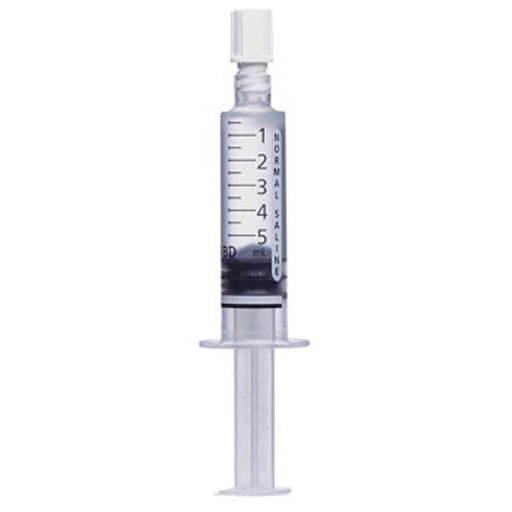
Flush and secure the catheter. Immediately attach a sterile saline syringe to the catheter’s Luer hub or extension set and gently flush the IV catheter. This confirms patency and clears blood from the line. (A built-in valve or clamp should prevent any large blood leak; BD’s “Big Mouth” Insyte design also helps contain flashback.) Then clamp the line (if applicable) and remove the syringe. Apply a transparent dressing or tape over the catheter and wings to secure it to the skin. Label the site with date/time and start the infusion as ordered.
Throughout, maintain aseptic technique (do not touch sterile needle/catheter parts). After securing, remove the tourniquet, dispose of the needle safely, and perform hand hygiene again. Follow your facility’s IV protocol (monitor the site for redness, patency, etc.).
Sizes (Gauges)
BD Insyte cannulas come in all the usual peripheral IV gauges. Typical sizes are:
-
24 gauge (Yellow): Very fine (≈0.6 mm diameter) – for neonates/infants or tiny veins.
-
22 gauge (Blue): Small (≈0.9 mm) – pediatric or elderly veins.
-
20 gauge (Pink): Standard adult IV (≈1.1 mm) – routine infusions and many medications.
-
18 gauge (Green): Large-bore (≈1.3 mm) – rapid fluids or blood transfusion. (Also available in 16G Gray and 14G Orange for high-flow/emergency use.)
These color-coded sizes correspond to standard flow capacities. For example, a 24G catheter (Yellow) has an inner diameter ≈0.60 mm (max ~36 mL/min), 22G (Blue) is ≈0.90 mm (max ~56 mL/min), 20G (Pink) is ≈1.10 mm (max ~40–80 mL/min), and 18G (Green) is ≈1.30 mm (max ~75–120 mL/min) These conventions are standard for peripheral IVs and match BD Insyte offerings.
In practice, using a BD Insyte IV catheter simply follows the standard IV insertion technique. Perform aseptic prep, puncture the vein with the needle (watching for flashback), advance the plastic catheter while withdrawing the needle, then flush and secure the line. Gauges range from very small (24G-yellow) to large (14–16G) depending on need.