 Skip to content






Filters
- AE3108 (1)
- Amsafe (1)
- DEHP Free (1)
- Extension Set (3)
- IV Extension Set Standard Bore 8 Inch Tubing (1)
- Luer Lock (2)
- Luer Lok (1)
- Robert Clamp (1)
- Roberts Clamp (1)
- Rotary Adapter (1)
- iv administration set (1)
- iv extension (1)
- iv set (1)
- Iv Sets (5)
- luer lock (1)
- microbore (1)
- Microbore IV Extenion Set (1)
- Microbore IV Extension Set (1)
- Microbore IV Set (1)
- needless (1)
- Extension Tubing (3)
- IV set (5)
- Needle Free Port (2)
- Rotating Luer Connector (1)
- Small Bore (5)
- Small Bore IV Set (1)
- Iv Start Kit (1)
- IV Supplies (3)
- Medical Tourniquets (1)
- Sterile IV (1)
- Tegaderm (1)
- IV Connecting Tubing (1)
- IV Extension Tubing (1)
- Microclave Needleless (1)
- Slide Clamp (2)
- IV Therapy (2)
- IV Tubing (2)
- McKesson (1)
- Minibore (1)
- MS401 (1)
- 473438 (1)
- braun (1)
- iv extension tubing (1)
- IV Kit (1)
- IV Products (1)
- High-Flow Filter (1)
- MC33150 (1)
- Micro Clave Connector (1)
- Pressure Infusion (1)
Filters
- AE3108 (1)
- Amsafe (1)
- DEHP Free (1)
- Extension Set (3)
- IV Extension Set Standard Bore 8 Inch Tubing (1)
- Luer Lock (2)
- Luer Lok (1)
- Robert Clamp (1)
- Roberts Clamp (1)
- Rotary Adapter (1)
- iv administration set (1)
- iv extension (1)
- iv set (1)
- Iv Sets (5)
- luer lock (1)
- microbore (1)
- Microbore IV Extenion Set (1)
- Microbore IV Extension Set (1)
- Microbore IV Set (1)
- needless (1)
- Extension Tubing (3)
- IV set (5)
- Needle Free Port (2)
- Rotating Luer Connector (1)
- Small Bore (5)
- Small Bore IV Set (1)
- Iv Start Kit (1)
- IV Supplies (3)
- Medical Tourniquets (1)
- Sterile IV (1)
- Tegaderm (1)
- IV Connecting Tubing (1)
- IV Extension Tubing (1)
- Microclave Needleless (1)
- Slide Clamp (2)
- IV Therapy (2)
- IV Tubing (2)
- McKesson (1)
- Minibore (1)
- MS401 (1)
- 473438 (1)
- braun (1)
- iv extension tubing (1)
- IV Kit (1)
- IV Products (1)
- High-Flow Filter (1)
- MC33150 (1)
- Micro Clave Connector (1)
- Pressure Infusion (1)
IV Extension Sets
-

 Sale 24%
IV Extension Set with Needless Injection Site, Luer Lock
Original price $ 4.98Current price $ 3.8057 reviews -
 Sale 36%
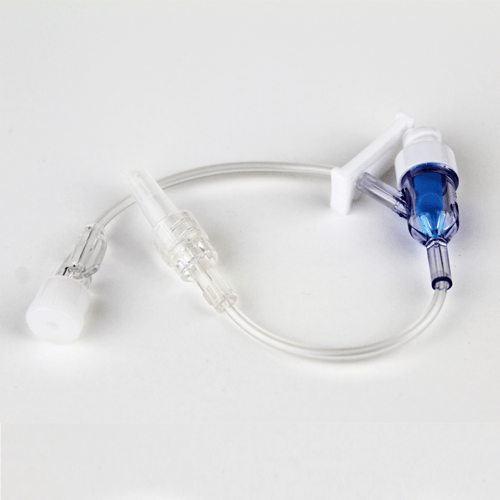
Microbore IV Extension Set Needleless Y-Site Luer Lock Slide Clamp
Original price $ 4.59Current price $ 2.9511 reviews -
 Sale 25%
IV Extension Set, Small Bore with Needle-Free Port, 7 Inch Tubing, Sterile
Original price $ 3.95Current price $ 2.951 review -
Sale 25%
IV Extension Set, Small Bore with Needle-Free Port and 7 Inch Tubing, Sterile
Original price $ 3.95Current price $ 2.951 review -
 Sale 48%
IV Start Kit With Tegaderm, Alcohol Preps, Tourniquet and IV Extension Set
Original price $ 9.95Current price $ 5.19 -
 Sale 40%
IV Extension Set Needle-Free Port Small Bore 7.5 Inch Tubing
Original price $ 4.95Current price $ 2.99 -

 Sale 35%
IV Extension Set Minibore without Port, Male & Female Luer Lock with Slide Clamp 7" Tubing 50/Box
Original price $ 59.95Current price $ 39.00 -
 Sale 19%
IV Extension Set Pressure Infusion Rotating Adapter, Small Bore 7" Tubing with Filter 50/Case
Original price $ 345.00Current price $ 279.00


People Also Searched For
IV Extension Sets
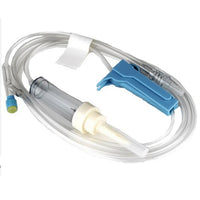
An IV extension set (or extension tubing) is a sterile, single-use piece of IV administration tubing that attaches between an existing IV catheter (or IV line) and the rest of the infusion system. It provides additional length and access ports to the primary IV line. For example, one infusion device supplier notes that extension sets “are used to increase the length of a primary infusion set” and come in many lengths/configurations. In practice, they have male and female Luer-lock connectors, clamps, and often injection ports or stopcocks built in. Extension sets are sold sterile and pyrogen-free; they are intended for single use only.
Types and Features
-
Tubing bore (diameter): Extension sets come in microbore (narrow, <2 mm ID) and macrobore (wider) sizes. Microbore lines have small priming volumes and deliver precise, low-rate infusions – they’re often used in pediatrics or anytime very small fluid volumes are needed. Macrobore tubing (>2 mm ID) permits high flow rates and large-volume infusions (e.g. adult or emergency use). BD reports that tubing size “impacts priming volume and fluid flow” – so microbore lines require less solution to prime but flow more slowly than wider tubing.
-
Length: Extension sets range from a few inches (tens of cm) up to several meters long. Short extension sets (tens of cm) simply extend the line by a short distance at the catheter hub. These provide a “closed extension” off the catheter, helping to stabilize the catheter and reduce jostling during infusion. They also add extra injection ports or clamps close to the catheter for flexibility. Long extension sets (hundreds of cm) let infusion pumps or bottles be placed far from the patient – for example, to allow syringe pumps to feed a single patient from outside an MRI scanner room or an isolation room. A long set can have multiple branches or Y-connectors for different infusions, enabling multiple medications via one line.
-
Material: Common materials include PVC (polyvinyl chloride – usually DEHP-free), polyurethane (PU), polyethylene (PE), or thermoplastic elastomers (TPE). Some sets use coated or low-sorbing tubing (e.g. PE-lined PVC) to reduce drug adsorption and avoid phthalate plasticizers. Medical suppliers emphasize DEHP- and latex-free construction, and non-pyrogenic materials are used.
-
Ports and fittings: Many extension lines include one or more injection ports (needleless connectors or male Luer ports) along their length to allow IV pushes. Some have built-in stopcocks or 3-way connectors, enabling infusion direction control or drug mixing. Specialized variants include anti-siphon (backcheck) valves to prevent tubing siphoning or blood backflow, pressure-rated/braided lines for power injection of contrast, inline filters (0.2-micron for air or endotoxin removal), light-protective opaque tubing, and built-in clamps (sliding or pinch clamps) to control flow. (For example, BD’s product list shows extension sets with anti-siphon valves, filters, and clamps at various lengths).
-
Priming volume: Because extension sets add more tubing, their “priming volume” (fluid needed to fill the line) can be non-negligible. Larger bore and longer tubing hold more fluid. As noted by BD, extension sets are offered in various bore sizes and lengths “with varying priming volumes depending on the tubing size and length”. In practice the line must be completely flushed of air (primed) before connecting to the patient, as with any IV line, and clinicians account for that extra volume when calculating doses.
Uses in IV Therapy
Extension sets are a flexible adjunct to IV therapy. Common scenarios include:
-
Connecting infusion pumps: They allow placing infusion pumps or IV bags away from the patient. For example, a syringe pump can use a long extension so that the pump sits at a nursing station or outside an MRI room while still infusing the patient. Multiple medication pumps can be joined via Y or multi-port extension sets to one IV catheter.
-
Pediatric infusions: Pediatric patients often use microbore extension tubing to deliver very low-volume infusions accurately, minimizing the dead space of the line.
-
Stabilizing catheter access: Even a short stub of extension tubing (several centimeters) reduces tension on the IV catheter during patient movement, lowering the risk of dislodgement. It also provides an extra port or clamp close to the catheter hub for intermittent injections or priming flushes.
-
Special procedures: In anesthesia (TIVA) or complex infusions, extension sets with multiple branches or stopcocks are used to combine drug lines. For radiology or cardiology, “pressure-rated” or braided extension sets can withstand the high (e.g. 15–20 bar) pressure of power injectors for contrast imaging.
In short, extension sets tailor the IV setup to the patient’s needs. They are not medications themselves, but passive devices. One supplier summarizes that extension sets “provide added length, access ports, or configuration flexibility to tailor infusions to individual patient needs”.
Setup and Handling
Extension sets are typically part of an IV infusion kit or added by the nurse/clinician. Key points:
-
Sterile connection: Always use aseptic technique when adding an extension set. The male Luer end of the extension connects to the female Luer hub of the IV catheter (or existing IV line) until “click” is heard. Ensure the connection is tight to prevent leaks or accidental disconnection.
-
Priming: After assembly, fluid (usually saline or the IV solution) must be flushed through the extension set to expel all air. Because these sets have a measurable priming volume (the suppliers note that volume varies by bore/length), it’s essential to push enough fluid so no air bubbles remain. Typically the extension clamp(s) are opened while flushing, then closed when done.
-
Flow control: Extension sets usually include built-in clamps (pinch or slide clamps) that can start/stop flow. Always keep the clamp closed when disconnecting or not infusing, to prevent free-flow of fluid or blood.
-
Injection port use: If the set has additional injection ports (needleless connectors), use them to give IV bolus medications. After injecting, flush the extension with saline to clear the drug into the bloodstream. (Remember that the injected drug must travel through the extension line, so flush volume should exceed the line’s dead space.)
-
Single use: Extension sets come sterile and are labeled for single use only. They should never be reused or shared between patients. After infusion is complete or between patients, the set (like any IV tubing) is discarded. This is in line with manufacturer guidance: “El dispositivo está destinado sólo para uso único y se proporciona estéril” (the device is intended only for single use and supplied sterile).
Safety and Precautions
As with any IV accessory, several precautions apply:
-
Infection control: Because the extension set connects directly to the bloodstream, sterility is critical. Disinfect all connectors before accessing (per hospital IV protocols). Change extension tubing per institutional policy or whenever contamination is suspected. Remember that every additional length of tubing adds surfaces for potential contamination, so extension sets should be handled carefully and replaced at appropriate intervals.
-
Air embolism: Never allow air into the extension line. Always prime and clamp appropriately. Check the set before use for any bubbles.
-
Immiscibility and medications: Some plastic materials can adsorb certain drugs (a concern with PVC vs. PE vs. non-sorbing tubing). Clinicians may choose low-sorbing (PE-lined) or non-PVC extension sets if giving lipid-soluble or incompatible drugs.
-
Pressure limitations: Standard extension sets are not designed to withstand high pressures unless specifically labeled (“pressure-rated”). Do not use a regular extension set with high-pressure infusions (e.g. power injectors) – special braided sets are required.
-
Hemodynamic effects: Note that adding length and volume to the IV line slightly increases the resistance, especially with microbore tubing. This can slow down infusion rates. Always account for this when programming pumps.
-
Clamps and valves: If using sets with anti-siphon or check valves, understand their function (they prevent free-flow/backflow). A closed clamp or malfunctioning valve may obstruct flow – always verify patency after setup.
-
Compatibility: Ensure connectors (Luer locks, valve types) match between the extension and the catheter/IV set. Mismatched connections can cause leaks or inadvertent disconnection.
In summary, IV extension sets are mechanical devices, not drugs. They are used to extend an IV delivery system and provide extra access points. When properly used, they allow medications and fluids to reach the patient safely and conveniently. All use should follow sterile technique and institutional IV infusion protocols.