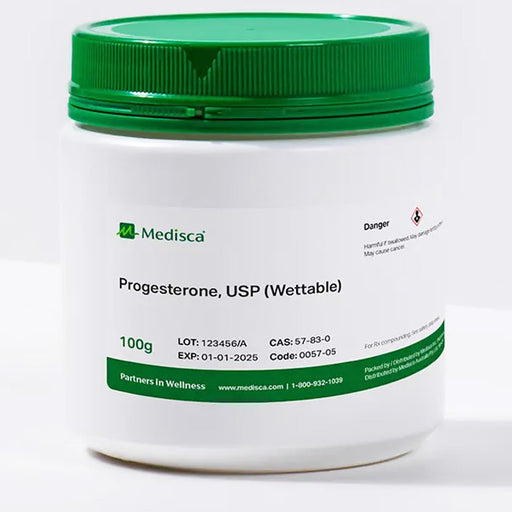
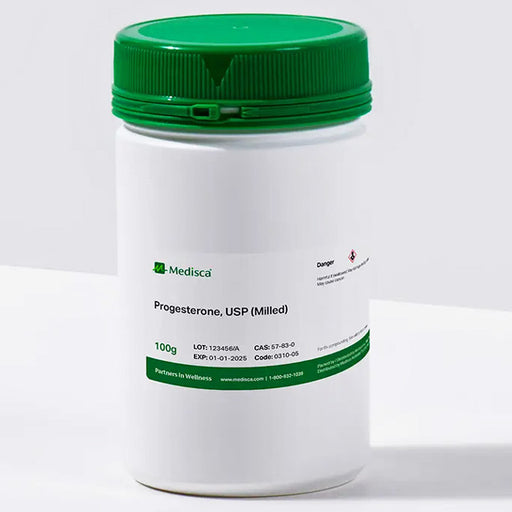
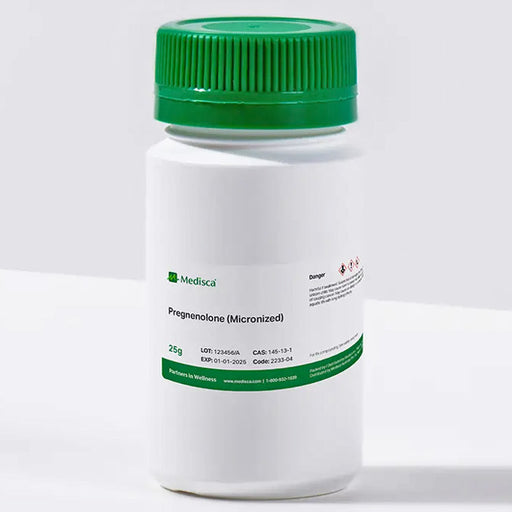
Pregnenolone (Micronized) API Powder
Pregnenolone powder is a synthetic version of the naturally occurring hormone pregnenolone. It is used in compounding medications as an active pharmaceutical ingredient (API) due to its ability to be formulated into different dosage forms, such as capsules, creams, gels, and injectables.
Pregnenolone (3β-hydroxypregn-5-en-20-one) is a steroid molecule with 21 carbon atoms. Its correct molecular formula is C₂₁H₃₂O₂ (molecular weight ≈316.5 g/mol); the formula C₂₁H₃₀O₂ given in some listings is incorrect (pregnenolone has two extra hydrogens due to a 3β-hydroxyl and a saturated steroid ring). Chemically it consists of four fused rings (the cyclopenta[a]phenanthrene steroid nucleus) with a ketone at the C-20 position and a β–hydroxyl at C-3, plus a double bond between C-5 and C-6. In its pure form it is a white to off-white crystalline powder that is hydrophobic (fat-soluble). The term “micronized” simply refers to the powder being very finely milled (particle size typically <50–75 micrometers) to improve uniform blending and dissolution in formulations. In compounding pharmacy terms, an “API powder” means the raw active hormone substance used for making capsules, creams, gels, etc (i.e. not a finished medicine.
What does Special Micronized Mean?
Progesterone USP is a white or creamy white, crystalline powder. It is stable in air. Special micronized Progesterone USP has the smallest particle size distribution of any progesterone in the portfolio to promote better bioavailability, 90% of particles are less than 5 microns and 100% are smaller than 10 microns.
Biological role:
In the human body, pregnenolone is an endogenous steroid hormone produced chiefly by the adrenal glands (and also by the brain and gonads) from cholesterol. It is the very first product of steroidogenesis: cholesterol is converted by side-chain cleavage into pregnenolone, which is then biochemically transformed into virtually all other steroid hormones (progesterone, glucocorticoids like cortisol, mineralocorticoids like aldosterone, androgens like testosterone, estrogens, and even downstream neurosteroids). Because of this, pregnenolone is often called a “precursor” or “pro-hormone” of the major adrenal and sex steroids. In addition to its endocrine function, pregnenolone itself acts as a neurosteroid in the brain: it modulates neuronal activity, promotes myelination, and has been studied for potential effects on cognition and mood. In fact, pregnenolone (and its sulfate ester) are found in high concentrations in the brain and are believed to improve memory and synaptic function. (For example, laboratory studies suggest pregnenolone can enhance neurotransmitter signaling and stabilize microtubules in neurons, which may underlie reported benefits for learning and memory.
Pregnenolone is often used in combination with other hormones, such as progesterone, to treat menopausal symptoms and hormone imbalances. It is also being studied for its potential use in improving memory and mood, as well as its anti-inflammatory and anti-aging effects.
By being special micronized, the powder is finely ground into smaller particles, making it easier to absorb into the body. This aids in its effectiveness as an API and allows it to be more easily incorporated into compounded medications.
Uses and claimed benefits:
Although pregnenolone was originally investigated in the mid-20th century for possible therapeutic uses, it is not an FDA-approved drug for any indication. Nevertheless, it became popular as a dietary supplement and compounding ingredient. Some compounding pharmacies and alternative-health practitioners formulate pregnenolone (micronized) capsules or creams – often in combination with progesterone – to treat menopausal symptoms, hormone imbalances, adrenal fatigue and low libido. It is also marketed in the supplement industry for a wide range of claims, such as boosting energy and athletic performance, enhancing memory, improving mood or “anti-aging,” and relieving stress or chronic pain. For example, some people take pregnenolone believing it will raise endogenous hormone levels (e.g. testosterone or estrogen) since it sits upstream in the steroid pathway. Other popular uses include trying to alleviate depression, anxiety, chronic fatigue, or cognitive decline. (Notably, pregnenolone is even included in some so-called “wild yam” or “DHEA” supplements, although consuming wild yam itself does not convert to pregnenolone in humans.)
However, it is important to emphasize that evidence for these claimed benefits is very limited. As noted by experts at the U.S. Anti-Doping Agency, pregnenolone has been advertised as an “anti-aging” or “energy-boosting” compound, but there is no clear scientific evidence that pregnenolone supplements can slow aging or significantly boost hormone levels. Likewise, the NIH’s WebMD resource lists numerous conditions (Alzheimer’s disease, bipolar disorder, sexual dysfunction, etc.) for which pregnenolone is sometimes used, but points out “there is no good scientific evidence to support these uses”. In short, while some preliminary research (mainly in animals or small clinical studies) suggests pregnenolone might influence brain function and stress responses, large well-designed clinical trials in people are lacking. At best, any observed cognitive or mood effects have been inconsistent. Thus most health professionals consider pregnenolone a research compound or supplement rather than a proven therapy.
Administration (micronized API):
In practice, micronized pregnenolone powder (C₂₁H₃₂O₂) is used by pharmacies to compound dosage forms. For example, a compounding pharmacy advertises that pregnenolone powder “is used in combination with other hormones (such as progesterone) to treat menopausal symptoms and hormone imbalances,” and is studied for potential roles in memory, mood, and inflammation. Because the plain powder is poorly soluble, it is finely milled (“micronized”) for uniform blending. Once compounded, pregnenolone is usually dosed in the 5–50 mg range (often once daily), although clinical dosing standards have not been established. Some products are marketed as sublingual tablets or transdermal gels. Note that gonadal lesions must prescribe any compounded preparation; it is not an over-the-counter prescription drug. In the U.S. it is usually sold as a dietary supplement or by prescription (e.g. “pregnenolone cream” requires RX) depending on how it is formulated.
Safety and side effects: Because pregnenolone is a steroid, it can have hormone-like side effects. Up to 12 weeks of oral use is generally considered “possibly safe”, but beyond that the safety profile is unknown. Reported side effects (mainly from small studies and user reports) include acne, increased body/facial hair, irritability or agitation, anxiety, restlessness, insomnia, sweating, headache, gastrointestinal upset, and tremors.. In other words, it can cause “steroid-like” effects – essentially an over-stimulation – affecting mood and skin. Because pregnenolone can convert in the body to estrogen and testosterone, people with hormone-sensitive conditions (such as breast, uterine or ovarian cancer, endometriosis, or uterine fibroids) are advised to avoid it. Pregnant or breastfeeding women should also not use pregnenolone (safety in pregnancy is unknown). The long-term effects of supplementing with pregnenolone are not well studied, and there is a risk that it could disrupt the normal hormonal axis, possibly suppressing endogenous hormone production over time. As with any endocrine therapy, careful medical supervision is recommended. In summary, pregnenolone supplements carry potential risks and are not mild harmless vitamins; any use should be discussed with a qualified healthcare provider.
Regulatory status:
Pregnenolone is not listed as a controlled anabolic steroid under U.S. law, and it is not on the World Anti-Doping Agency (WADA) prohibited list. Thus athletes are currently allowed to use pregnenolone without violating doping rules, but this status could change if WADA updates its list. (USADA notes that no Therapeutic Use Exemption is needed since it is not banned).) In terms of FDA regulation, pregnenolone is a gray area: the FDA has never formally approved it as a drug, and one FDA warning letter even treated synthetically produced pregnenolone as an “unapproved new drug” when used in a compounding pharmacy). In practice, pregnenolone is widely sold as a dietary supplement in many countries (including the U.S. and Europe), but the FDA’s position is that it could be considered a drug if marketed with therapeutic claims. Consumers should therefore buy from reputable sources, since supplement quality can vary. Because it is an active hormone, pregnenolone powder is intended for compounding or research use; non-pharmaceutical suppliers of bulk powder are not quality-controlled like prescription products.
Pregnenolone (micronized) is a bioidentical steroid precursor (C₂₁H₃₂O₂) used in compounded hormone therapies and dietary supplements. It plays a key role in the body’s steroid hormone pathways and has some neuroactive properties. Commercially, it is marketed with many claims (anti-aging, cognitive enhancer, libido booster, etc.), but high-quality evidence for most benefits is lacking. Users should be aware of its hormonal effects and potential side effects (acne, mood changes, etc.), and should use it only under a doctor’s guidance. Pregnenolone is currently not banned in sport and is legally available as a supplement, but it is essentially an unapproved drug in the eyes of regulators.
Chemical Formula
C21H30O2
Hazardous Drug: Yes
Storage Conditions
Store in original container, tightly sealed, protected from direct sunlight and moisture. Controlled room temperature indicates a temperature 20° to 25°C (68° to 77°F); that results in a mean kinetic temperature calculated to be not more than 25°C; and that allows for excursions between 15° and 30°C (59° and 86°F) that are experienced in pharmacies, hospitals, and warehouses. Provided the mean kinetic temperature remains in the allowed range, transient spikes up to 40°C (104°F) are permitted as long as they do not exceed 24 hours.