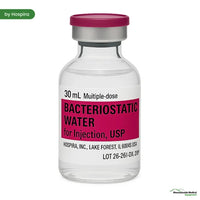
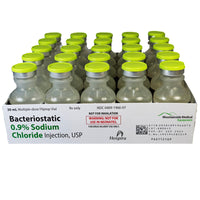
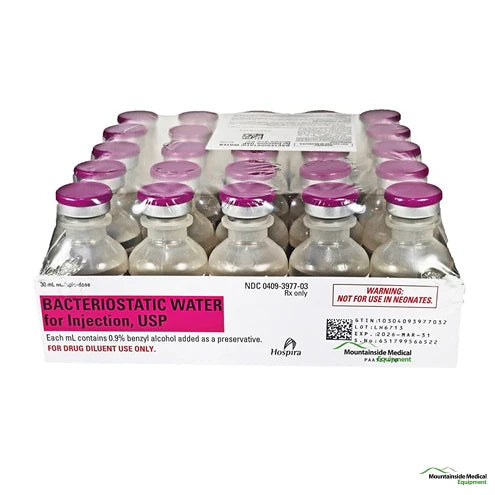
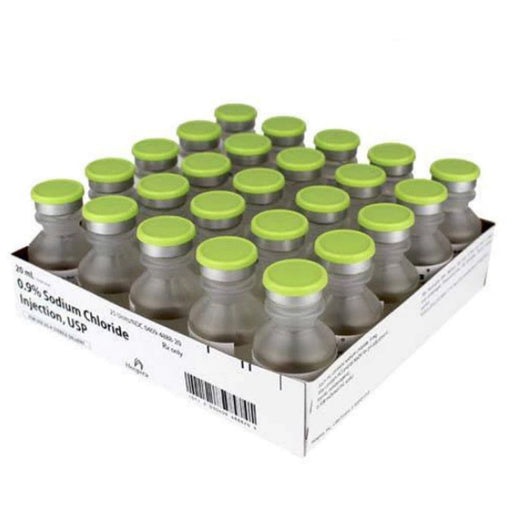
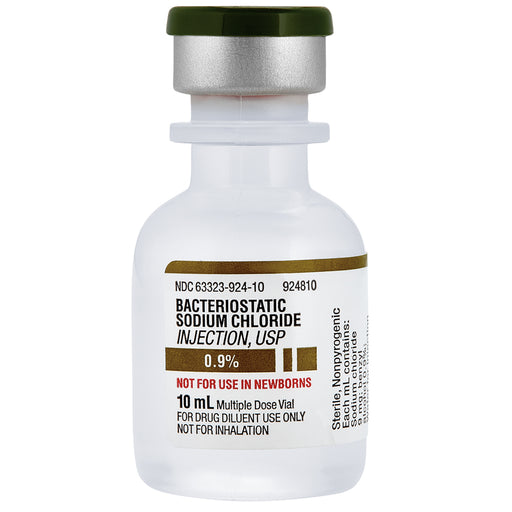
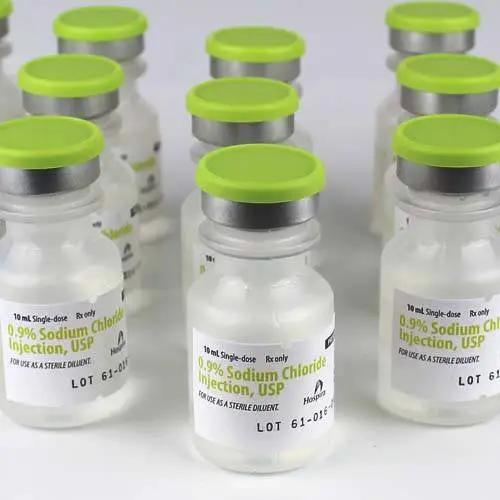
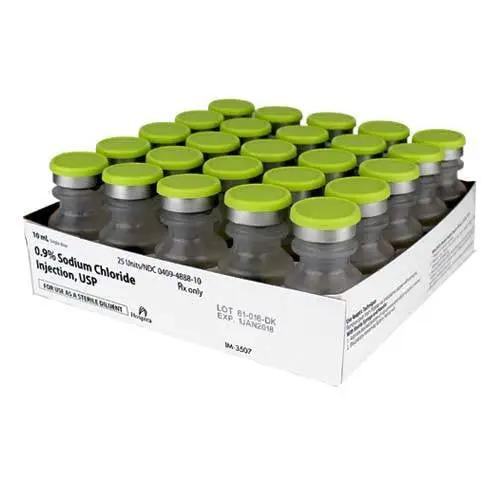
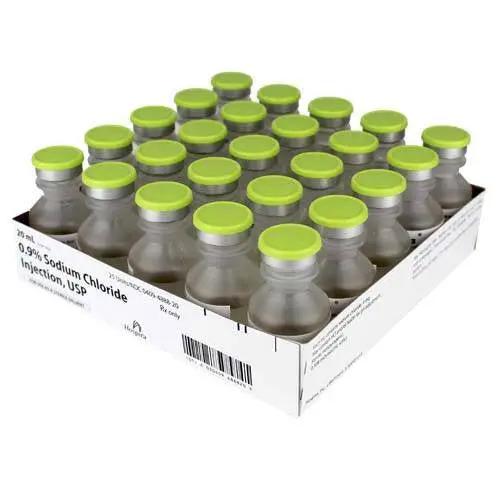
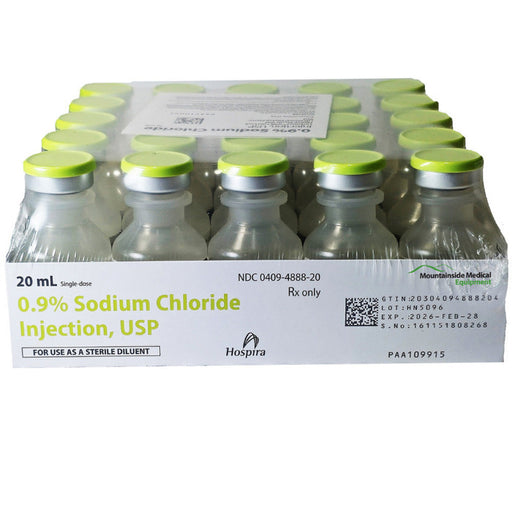
Bacteriostatic Sodium Chloride 0.9% Saline Injection Multiple Dose 30 ml x 25/Pack (Rx)


Bacteriostatic Sodium Chloride 0.9% Injection is a sterile normal saline solution (0.9% sodium chloride in water) that contains a small amount of a bacteriostatic preservative. In most formulations, the preservative is benzyl alcohol (0.9% benzyl alcohol per mL), which inhibits the growth of bacteria. The presence of this preservative keeps the solution sterile between uses, allowing the product to be packaged in a multiple-dose vial for repeated withdrawals without contamination. In other words, “bacteriostatic” means it prevents bacteria from growing, so the same vial of saline can be used multiple times (within its recommended timeframe) instead of being single-use.
This injection is essentially 0.9% sodium chloride (NaCl) dissolved in sterile water—with 9 mg of sodium chloride per milliliter, making it isotonic with blood and tissues. The isotonic nature means it has the same salt concentration as normal body fluids, so it won’t cause cells to shrink or swell when injected. In addition to salt, each milliliter contains about 9 mg of benzyl alcohol (0.9%) as the bacteriostatic agent. The benzyl alcohol does not treat infection, but its job is to keep the solution sterile by inhibiting bacterial growth if the vial is used more than once. The solution is labeled “nonpyrogenic”, meaning it’s free from substances that cause fever, and it’s intended for parenteral use (injection). Because it’s a USP-grade preparation, it meets quality standards for purity and sterility required for injectable solutions.
Bacteriostatic 0.9% Sodium Chloride Injection is not a medication on its own – it’s a diluent or solvent used to prepare other drugs for injection. According to its labeling, this solution is indicated only for diluting or dissolving drugs for injection (whether intravenous (IV), intramuscular (IM), or subcutaneous (SC)). For example, if you have a vial of powdered medication that needs to be injected, you might add this bacteriostatic saline to reconstitute (dissolve) the powder into a liquid form for injection. Similarly, it can be used to dilute concentrated drugs to the proper strength before injecting them. Healthcare providers also sometimes use sterile saline solutions to flush IV lines or injection sites, but in many cases preservative-free saline is preferred for flushing (especially in sensitive patients). The key point is that Bacteriostatic Sodium Chloride 0.9% Injection provides a sterile salt-water medium for mixing medications, and its bacteriostatic property allows the vial to be used for multiple doses or multiple patients (with proper sterile technique) instead of being discarded after a single use.
NDC: 0409-1966-07 | UPC: 304091966024 Fast Shipping | Bulk Pack | FDA-Approved | Trusted by Hospitals Everywhere
Provide your clinical team with the safest, most reliable multi-dose injectable saline available on the market—choose Pfizer Bacteriostatic Sodium Chloride for every reconstitution, dilution, and flush need.
Bacteriostatic Sodium Chloride 0.9% Injection is indicated for:
| Attribute | Detail |
|---|---|
| Product Name | Bacteriostatic Sodium Chloride 0.9% Injection, USP |
| Manufacturer | Pfizer Inc. (formerly Hospira) |
| NDC | 0409-1966-07 |
| UPC | 304091966024 |
| Concentration | 0.9% sodium chloride (9 mg NaCl per mL) |
| Preservative | Benzyl alcohol 0.9% (9 mg/mL) |
| Vial Size | 30 mL |
| Pack Quantity | 25 vials per pack |
| Vial Type | Multiple-dose vial |
| Tonicity | Isotonic |
| Pyrogenicity | Nonpyrogenic |
| Grade | USP |
| Routes of Administration | IV, IM, SC (as diluent only) |
| Rx Status | Prescription only (Rx) |
| Storage | Controlled room temperature 20°C–25°C (68°F–77°F); protect from light; do not freeze |
| Regulatory Compliance | Manufactured under FDA cGMP per 21 CFR Parts 210 and 211 |
Not for direct IV infusion without proper mixing with medications unless specifically indicated.
NEVER use bacteriostatic saline in neonates or infants due to risk of benzyl alcohol toxicity (“gasping syndrome”).
Common Side Effects:
Serious Adverse Reactions:
Warnings:
This product is intended for use by qualified healthcare professionals or under the guidance of a licensed medical provider. It is not a substitute for professional medical advice, diagnosis, or treatment.
Bacteriostatic Sodium Chloride 0.9% Injection is a prescription-only (Rx) product. Purchase requires valid medical licensure. It is the responsibility of the purchasing professional to ensure compliance with all applicable federal, state, and local regulations governing the purchase, storage, handling, and administration of prescription pharmaceutical products.
This product contains benzyl alcohol 0.9% as a preservative. Benzyl alcohol is contraindicated in neonates and premature infants. This product is not indicated for large-volume parenteral administration or IV hydration.
Product information provided on this page references FDA-approved prescribing information (NDC 0409-1966-07) and USP compendial standards. Clinical decisions regarding product selection, reconstitution volumes, and administration must be made by a licensed healthcare professional in accordance with applicable clinical guidelines and facility protocols.
Mountainside Medical Equipment supplies this product for use by licensed healthcare professionals only. Content on this page is informational and does not constitute medical advice.
Bacteriostatic saline is a 0.9% sodium chloride (normal saline) solution that contains benzyl alcohol 0.9% as a preservative. The sodium chloride concentration is identical to standard preservative-free saline — isotonic, 9 mg NaCl per mL. The difference is the benzyl alcohol, which inhibits bacterial growth between vial uses. This makes the product safe to use as a multi-dose vial, allowing repeated withdrawals without the contamination risk that would apply to a standard saline vial after its first puncture. Preservative-free normal saline does not contain benzyl alcohol and must be discarded after a single use or after the vial is opened.
Not exactly. Both are 0.9% sodium chloride solutions, and both are isotonic. But standard normal saline (preservative-free) does not contain a bacteriostatic agent. Bacteriostatic saline contains benzyl alcohol 0.9%, which prevents bacterial contamination between uses. Clinically, the two are not interchangeable in all settings — the benzyl alcohol in bacteriostatic saline is a contraindication in neonates, and some clinical protocols specify preservative-free saline for certain applications. For multi-dose reconstitution and dilution workflows in adult patients, bacteriostatic saline is the appropriate choice.
Yes. Bacteriostatic sodium chloride 0.9% is widely used by licensed practitioners for reconstituting peptide-based injectable compounds, including GLP-1 receptor agonists such as tirzepatide, and growth hormone-related peptides such as tesamorelin and retatrutide. The bacteriostatic preservative extends the usable life of the reconstituted solution compared to using preservative-free saline, which is one reason practitioners in compounding-adjacent clinical settings favour this product for peptide reconstitution. Specific reconstitution volumes and concentrations must be determined by the prescribing or administering healthcare professional according to applicable clinical protocols.
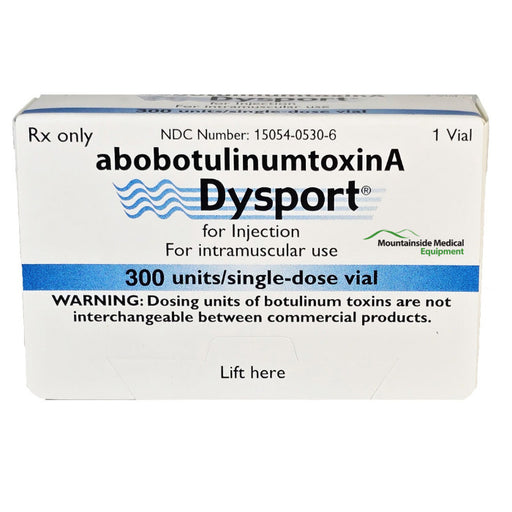
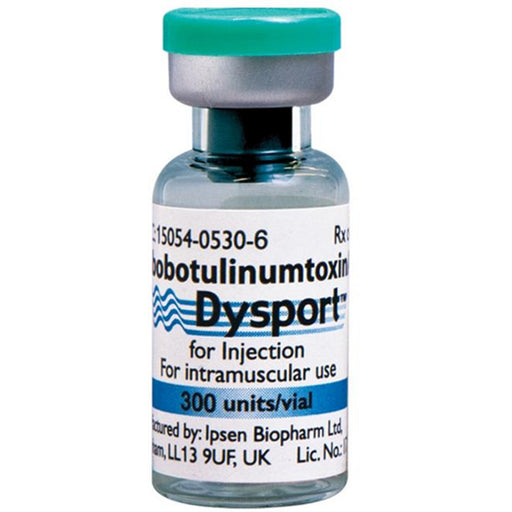
Bacteriostatic saline is used by some aesthetic practitioners to reconstitute botulinum toxin products. The isotonic sodium chloride formulation is considered by some injectors to be associated with less injection-site discomfort compared to hypotonic diluents. That said, botulinum toxin manufacturer prescribing information specifies recommended diluents, and practitioners should follow those guidelines. Any reconstitution decision should be made by the licensed injector in accordance with their clinical training and the manufacturer's approved prescribing information.
The benzyl alcohol preservative (0.9%, 9 mg/mL) in this product is contraindicated in neonates and premature infants. Benzyl alcohol toxicity in neonates was documented in published case series and FDA communications beginning in the early 1980s, describing a syndrome characterised by metabolic acidosis, gasping respirations, CNS depression, and in some cases death — now referred to as 'gasping syndrome.' Neonates lack the hepatic enzyme capacity to metabolise benzyl alcohol effectively, leading to toxic accumulation of benzoic acid. Preservative-free saline must be used in any application involving neonates.
USP General Chapter <797> guidance and standard clinical practice generally support a 28-day beyond-use date for multi-dose vials after first puncture when stored at controlled room temperature (20°C–25°C). However, the applicable beyond-use date can vary depending on your facility's standard operating procedures, your state board of pharmacy regulations, and the specific storage conditions in your clinical environment. Always verify the discard policy with your facility pharmacist and applicable regulatory requirements. Do not use the vial beyond 28 days from first puncture unless your facility SOPs specify otherwise based on regulatory guidance.
Retail pharmacies such as Walgreens and CVS typically stock preservative-free saline for outpatient use. Multi-dose bacteriostatic sodium chloride in the 25-vial bulk pack format is a wholesale clinical supply product, and retail availability is inconsistent. Mountainside Medical supplies this product directly to licensed healthcare professionals with fast US shipping and free delivery on orders over $100. First-time buyers receive 5% off. Orders can be placed online or by calling +1 (888) 687-4334.
Yes. Bacteriostatic Sodium Chloride 0.9% Injection is an Rx-only product. A valid medical license is required to purchase. Mountainside Medical verifies licensure as part of the order process for prescription-designated products. This applies to physicians, nurses, pharmacists, EMS professionals, dentists, veterinarians, and other licensed healthcare providers. If you have questions about the licensing verification process, contact the team at sales@mountainside-medical.com or call +1 (888) 687-4334.
These are two distinct products. Bacteriostatic sodium chloride 0.9% (this product) is an isotonic solution — it contains 9 mg/mL sodium chloride in addition to the benzyl alcohol preservative, giving it the same osmolality as blood and body fluids. Bacteriostatic water for injection (BWFI) is a hypotonic solution — it contains only sterile water and benzyl alcohol, with no sodium chloride. BWFI has lower osmolality and is not isotonic. The choice between the two depends on the medication being reconstituted: some drugs specify one diluent over the other in their prescribing information, and the tonicity of the final reconstituted solution matters for the administration route and patient tolerance.
Bacteriostatic Sodium Chloride 0.9% Injection is a sterile normal saline solution (0.9% sodium chloride in water) that contains a small amount of a bacteriostatic preservative. In most formulations, the preservative is benzyl alcohol (0.9% benzyl alcohol per mL), which inhibits the growth of bacteria. The presence of this preservative keeps the solution sterile between uses, allowing the product to be packaged in a multiple-dose vial for repeated withdrawals without contamination. In other words, “bacteriostatic” means it prevents bacteria from growing, so the same vial of saline can be used multiple times (within its recommended timeframe) instead of being single-use.
This injection is essentially 0.9% sodium chloride (NaCl) dissolved in sterile water—with 9 mg of sodium chloride per milliliter, making it isotonic with blood and tissues. The isotonic nature means it has the same salt concentration as normal body fluids, so it won’t cause cells to shrink or swell when injected. In addition to salt, each milliliter contains about 9 mg of benzyl alcohol (0.9%) as the bacteriostatic agent. The benzyl alcohol does not treat infection, but its job is to keep the solution sterile by inhibiting bacterial growth if the vial is used more than once. The solution is labeled “nonpyrogenic”, meaning it’s free from substances that cause fever, and it’s intended for parenteral use (injection). Because it’s a USP-grade preparation, it meets quality standards for purity and sterility required for injectable solutions.
Bacteriostatic 0.9% Sodium Chloride Injection is not a medication on its own – it’s a diluent or solvent used to prepare other drugs for injection. According to its labeling, this solution is indicated only for diluting or dissolving drugs for injection (whether intravenous (IV), intramuscular (IM), or subcutaneous (SC)). For example, if you have a vial of powdered medication that needs to be injected, you might add this bacteriostatic saline to reconstitute (dissolve) the powder into a liquid form for injection. Similarly, it can be used to dilute concentrated drugs to the proper strength before injecting them. Healthcare providers also sometimes use sterile saline solutions to flush IV lines or injection sites, but in many cases preservative-free saline is preferred for flushing (especially in sensitive patients). The key point is that Bacteriostatic Sodium Chloride 0.9% Injection provides a sterile salt-water medium for mixing medications, and its bacteriostatic property allows the vial to be used for multiple doses or multiple patients (with proper sterile technique) instead of being discarded after a single use.
NDC: 0409-1966-07 | UPC: 304091966024 Fast Shipping | Bulk Pack | FDA-Approved | Trusted by Hospitals Everywhere
Provide your clinical team with the safest, most reliable multi-dose injectable saline available on the market—choose Pfizer Bacteriostatic Sodium Chloride for every reconstitution, dilution, and flush need.
Bacteriostatic Sodium Chloride 0.9% Injection is indicated for:
| Attribute | Detail |
|---|---|
| Product Name | Bacteriostatic Sodium Chloride 0.9% Injection, USP |
| Manufacturer | Pfizer Inc. (formerly Hospira) |
| NDC | 0409-1966-07 |
| UPC | 304091966024 |
| Concentration | 0.9% sodium chloride (9 mg NaCl per mL) |
| Preservative | Benzyl alcohol 0.9% (9 mg/mL) |
| Vial Size | 30 mL |
| Pack Quantity | 25 vials per pack |
| Vial Type | Multiple-dose vial |
| Tonicity | Isotonic |
| Pyrogenicity | Nonpyrogenic |
| Grade | USP |
| Routes of Administration | IV, IM, SC (as diluent only) |
| Rx Status | Prescription only (Rx) |
| Storage | Controlled room temperature 20°C–25°C (68°F–77°F); protect from light; do not freeze |
| Regulatory Compliance | Manufactured under FDA cGMP per 21 CFR Parts 210 and 211 |
Not for direct IV infusion without proper mixing with medications unless specifically indicated.
NEVER use bacteriostatic saline in neonates or infants due to risk of benzyl alcohol toxicity (“gasping syndrome”).
Common Side Effects:
Serious Adverse Reactions:
Warnings:
This product is intended for use by qualified healthcare professionals or under the guidance of a licensed medical provider. It is not a substitute for professional medical advice, diagnosis, or treatment.
Bacteriostatic Sodium Chloride 0.9% Injection is a prescription-only (Rx) product. Purchase requires valid medical licensure. It is the responsibility of the purchasing professional to ensure compliance with all applicable federal, state, and local regulations governing the purchase, storage, handling, and administration of prescription pharmaceutical products.
This product contains benzyl alcohol 0.9% as a preservative. Benzyl alcohol is contraindicated in neonates and premature infants. This product is not indicated for large-volume parenteral administration or IV hydration.
Product information provided on this page references FDA-approved prescribing information (NDC 0409-1966-07) and USP compendial standards. Clinical decisions regarding product selection, reconstitution volumes, and administration must be made by a licensed healthcare professional in accordance with applicable clinical guidelines and facility protocols.
Mountainside Medical Equipment supplies this product for use by licensed healthcare professionals only. Content on this page is informational and does not constitute medical advice.
Bacteriostatic saline is a 0.9% sodium chloride (normal saline) solution that contains benzyl alcohol 0.9% as a preservative. The sodium chloride concentration is identical to standard preservative-free saline — isotonic, 9 mg NaCl per mL. The difference is the benzyl alcohol, which inhibits bacterial growth between vial uses. This makes the product safe to use as a multi-dose vial, allowing repeated withdrawals without the contamination risk that would apply to a standard saline vial after its first puncture. Preservative-free normal saline does not contain benzyl alcohol and must be discarded after a single use or after the vial is opened.
Not exactly. Both are 0.9% sodium chloride solutions, and both are isotonic. But standard normal saline (preservative-free) does not contain a bacteriostatic agent. Bacteriostatic saline contains benzyl alcohol 0.9%, which prevents bacterial contamination between uses. Clinically, the two are not interchangeable in all settings — the benzyl alcohol in bacteriostatic saline is a contraindication in neonates, and some clinical protocols specify preservative-free saline for certain applications. For multi-dose reconstitution and dilution workflows in adult patients, bacteriostatic saline is the appropriate choice.
Yes. Bacteriostatic sodium chloride 0.9% is widely used by licensed practitioners for reconstituting peptide-based injectable compounds, including GLP-1 receptor agonists such as tirzepatide, and growth hormone-related peptides such as tesamorelin and retatrutide. The bacteriostatic preservative extends the usable life of the reconstituted solution compared to using preservative-free saline, which is one reason practitioners in compounding-adjacent clinical settings favour this product for peptide reconstitution. Specific reconstitution volumes and concentrations must be determined by the prescribing or administering healthcare professional according to applicable clinical protocols.
Bacteriostatic saline is used by some aesthetic practitioners to reconstitute botulinum toxin products. The isotonic sodium chloride formulation is considered by some injectors to be associated with less injection-site discomfort compared to hypotonic diluents. That said, botulinum toxin manufacturer prescribing information specifies recommended diluents, and practitioners should follow those guidelines. Any reconstitution decision should be made by the licensed injector in accordance with their clinical training and the manufacturer's approved prescribing information.
The benzyl alcohol preservative (0.9%, 9 mg/mL) in this product is contraindicated in neonates and premature infants. Benzyl alcohol toxicity in neonates was documented in published case series and FDA communications beginning in the early 1980s, describing a syndrome characterised by metabolic acidosis, gasping respirations, CNS depression, and in some cases death — now referred to as 'gasping syndrome.' Neonates lack the hepatic enzyme capacity to metabolise benzyl alcohol effectively, leading to toxic accumulation of benzoic acid. Preservative-free saline must be used in any application involving neonates.
USP General Chapter <797> guidance and standard clinical practice generally support a 28-day beyond-use date for multi-dose vials after first puncture when stored at controlled room temperature (20°C–25°C). However, the applicable beyond-use date can vary depending on your facility's standard operating procedures, your state board of pharmacy regulations, and the specific storage conditions in your clinical environment. Always verify the discard policy with your facility pharmacist and applicable regulatory requirements. Do not use the vial beyond 28 days from first puncture unless your facility SOPs specify otherwise based on regulatory guidance.
Retail pharmacies such as Walgreens and CVS typically stock preservative-free saline for outpatient use. Multi-dose bacteriostatic sodium chloride in the 25-vial bulk pack format is a wholesale clinical supply product, and retail availability is inconsistent. Mountainside Medical supplies this product directly to licensed healthcare professionals with fast US shipping and free delivery on orders over $100. First-time buyers receive 5% off. Orders can be placed online or by calling +1 (888) 687-4334.
Yes. Bacteriostatic Sodium Chloride 0.9% Injection is an Rx-only product. A valid medical license is required to purchase. Mountainside Medical verifies licensure as part of the order process for prescription-designated products. This applies to physicians, nurses, pharmacists, EMS professionals, dentists, veterinarians, and other licensed healthcare providers. If you have questions about the licensing verification process, contact the team at sales@mountainside-medical.com or call +1 (888) 687-4334.
These are two distinct products. Bacteriostatic sodium chloride 0.9% (this product) is an isotonic solution — it contains 9 mg/mL sodium chloride in addition to the benzyl alcohol preservative, giving it the same osmolality as blood and body fluids. Bacteriostatic water for injection (BWFI) is a hypotonic solution — it contains only sterile water and benzyl alcohol, with no sodium chloride. BWFI has lower osmolality and is not isotonic. The choice between the two depends on the medication being reconstituted: some drugs specify one diluent over the other in their prescribing information, and the tonicity of the final reconstituted solution matters for the administration route and patient tolerance.
You need an account to add products to your wishlist. Log in or create an account to start saving your favorites.